2/22/2006

Capital Stock Basics & VC Term Sheet Provisions

VC Experts has partnered with Wiley Finance, the publisher of The Handbook of Financing Growth, and excerpted the most relevant content on basic private equity and venture deal structures. This Buzz of the Week reviews capital stock structure of a company. "The authors give a real world example of how Liquidation Preferences affect pre- and post-money valuation, voting rights, and what happens to investors and management when there are multiple layers of financing. They also review registration rights, anti-dilution clauses and all standard term sheet provisions." The equity investment term sheet is particularly well covered, stating:

"In many respects the term sheet is where the most action occurs in the investment process. As the parties negotiate the terms of the deal, valuation of the company and the role of existing management in the ongoing entity will be carefully documented. Several concepts relating to valuation of the company are important to understand in the negotiating process. The impact of slight nuances in the words used to finalize the term sheet can have dramatic impacts on the amount of equity retained by the owners." Such terms include:

Premoney and Postmoney Valuation
Liquidation Preference
Voting Rights
Protective Provisions
Antidilution Provisions
Redemption
Registration Rights
Board Composition
Employee Stock Options
Founder Share Vesting


The Four Agreements

don miguel ruiz's code for life

agreement 1

Be impeccable with your word - Speak with integrity. Say only what you mean. Avoid using the word to speak against yourself or to gossip about others. Use the power of your word in the direction of truth and love.

agreement 2

Don’t take anything personally - Nothing others do is because of you. What others say and do is a projection of their own reality, their own dream. When you are immune to the opinions and actions of others, you won’t be the victim of needless suffering.

agreement 3

Don’t make assumptions - Find the courage to ask questions and to express what you really want. Communicate with others as clearly as you can to avoid misunderstandings, sadness and drama. With just this one agreement, you can completely transform your life.

agreement 4

Always do your best - Your best is going to change from moment to moment; it will be different when you are healthy as opposed to sick. Under any circumstance, simply do your best, and you will avoid self-judgment, self-abuse and regret.

From this article from businessballs.com.

2/21/2006

Cyberspace Law Revisited

"Ten years ago, David R. Johnson and David G. Post published in First Monday their influential paper on law and the Internet, “Law and Borders — The Rise of Law in Cyberspace.” Revisit “Law and Borders” and examine its impact ten years later" in this collection of articles from First Monday that includes:

Law and Borders: The Rise of Law in Cyberspace
by David R. Johnson and David G. Post (originally published in May 1996)

The Great Debate — Law in the Virtual World
by David G. Post and David R. Johnson

Virtual Borders: The Interdependence of Real and Virtual Worlds
by James Grimmelmann

Dispute Resolution Without Borders: Some Implications for the Emergence of Law in Cyberspace
by Ethan Katsh

The Life of the Law Online
by David R. Johnson

Found via this post from Diane Levin's Online Guide to Mediation.

Technorati Tags: , , , ,

Simple Outline for a Business Plan

"A good business plan will define what your business is about, where you expect it to go in the future and how you will get there. The following outline the essentials of a good business plan.

1. Executive Summary...
2. Table of Contents...
3. Company Description...
4. Market Analysis...
5. Technology...
6. Business Operations or Manufacturing...
7. Management and Ownership...
8. Organization and Personnel...
9. Capital and Usage...
10. Financial {Projections]...
11. Appendices..."

Read more in this article from morebusiness.com.

Technorati Tags: , business plan, ,

2/20/2006

Global Trade Tutorial

Whether you're thinking about getting involved in international trade, or are already exporting, a review of the extensive materials in TradePort's Global Trade Tutorial will help you obtain a better understanding of how to succeed. The tutorial covers the following topics:

Getting Started
Researching Your Markets
Developing Export Strategy
Focusing on the Details
Understanding the Rules of Trade
Financing Your Exports

The site also contains a comprehensive Glossary of International Trade Terms that is well worth bookmarking.

2/19/2006

How to Build Long Term Client Relationships

"There are many ways to keep customers for life, they include:

Deliver on your promises....
Treat your customers well....
Go beyond....
Pay more attention to your customers than your bottom line....
Nurture your employees....
Make attractive offers....
Guarantee your products and services....
Reward your customers....
Thank customers and keep in touch....
Return phone calls promptly
Be accessible to your clients
Be credible and become an expert in your field
Show empathy for customer problems
Have helpful customer service and support systems
Have a customer advisory panel for feedback
Never show indifference to your customers"

Read more in this Small Business Bible post found via this Small Business CEO post.

2/16/2006

Ten Steps to Start Your Business

“Here they are—the 10 steps to starting your dream business...

Step 1: Create a Life Plan
Step 2: Choose a Business Model
Step 3: Create a Business Plan
Step 4: Select a Structure
Step 5: Create Key Assets
Step 6: Find the Funding
Step 7: Organize Logistics
Step 8: Find Great People
Step 9: Establish a Brand
Step 10: Market and Sell..."

Visit this Startup Nation webpage to read, listen, download and follow links to related resources.

Technorati Tags: , , , ,

Data Protection Basics

"There are certain privacy and security rules that every business or organization should live by:

· Identify the sensitive information collected from customers...Keep this data only as long as needed. Block access or truncate display of it for anyone without a specific need to see it. Make your employees aware of what is sensitive.

· Data in transit are data at risk. Send only the data needed by the recipient. Truncate or encrypt all sensitive information. Establish appropriate data retention and destruction requirements...

· Screen all employees with access to sensitive information. Allow access only to what an employee needs to do his job. Monitor employee access to customer information...

· Include security requirements in every vendor contract. Interview your vendors’ security employees. Read the privacy policy of your vendors. Understand the legal requirements for offshore vendors.

· Overreact if you have a security breach...Hoping the problem goes away only ensures that it gets bigger.

· Learn from the marketplace. Don’t make commitments you can’t live up to...If your security practices aren’t changing, you aren’t keeping up with new risks..."

Read more in this DMNews.com article found via this Privacy and Security Law Blog post.

Business Plans Handbook

Here is an interesting collection of Business Plans that is part of a more comprehensive business information site: Reference For Business - Encyclopedia of Small Business, Business Biographies, Business Plans, and Encyclopedia of American Industries.

2/13/2006

Advisory Board Advantages Raise Legal Issues

This excellent post by Ross Mayfield describes the benefits of an effective Board of Advisors (BoA), how to handle conflicts of interest and best practices for disclosure stating:

"I liken the role of a BoA as a group with strong ties to the company, playing a role in it's social network as the first degree. Initially, names alone provide credibility or thought leadership, but to really gain advantage, a structure such as above needs to ensure information flow and set expectations...Some of the benefits of a BoA:

Thought leadership
Technical advice
Strategic advice
Trusted feedback loop
Network into customers, partners and VCs
Increases the perception of scale and maturity
Properly disclosed influence through blogs and press
Cash-conservative compensation..."

Other good resources on advisory boards include this article by Auren Hoffman for Business Week and this post by Steven Bayle who points out, that when properly structured and managed, an advisory board can establish credibility in the marketplace and provide valuable assistance and advice on topics such as the company’s strategy, product offerings and technological direction.

As you might imagine, advisory boards raise legal issues. While the posts noted above touch on some of the legal issues involved in creating and serving on an advisory board, I would add the following, taken in part from this Tech Biz Florida article:

Advisory board members:

§ Do not have same statutory protections afforded to elected Boards of Directors
§ Do not vote as part of the Board of Directors.
§ Do do not have policy-making powers.
§ Are not officers or employees of the company.
§ Do not have management authority in the company.

If your company decides to establish an advisory board, it should do so in a way that minimizes any risk of liability for the advisory director. Steps that can be taken include:

§ A written description of the role and responsibility of advisory board members, which makes it clear that they have no policy-making powers, have no voting authority, and have no management authority in the company, but their role is solely advisory, subject to the review and approval of the company's Board of Directors and/or senior management.

§ Written records of the proceedings of advisory board meetings, which will reflect that the advisory board was acting consistent with the written description of its role in the company.

§ Review of the company's D&O Insurance policy to make certain that the advisory directors are sufficiently protected if a lawsuit is filed against them.

§ Review of the company's articles of incorporation and bylaws and local law to make certain that the company will be obligated to indemnify advisory directors to the full extent allowed by law, and consideration of separate indemnity agreements between the company and its advisory directors.

2/12/2006

D&O Insurance Policies Primer

"Few companies or directors/officers review the precise wordings of their policies (whether they be D&O or products liability or property). By the time lawyers are involved in the claims side of things it may be too late. By investing the time upfront in scrutinizing the wording carefully, one can be best assured that the protection that is intended to be obtained through the purchase of a policy will be there when needed."

This comprehensive post from Insurance Scrawl explains the basics as follows:

"In general, insurance policies for directors and officers provide coverage for defense costs and liability payments (both judgments and settlements) for covered wrongful acts if a claim is made against the insured during the policy period. This is often referred to as “Side A” coverage. In addition, most policies afford coverage for the company’s own expenses incurred in indemnifying covered persons pursuant to the corporate indemnity in the company by-laws. This is often referred to as “Side B” coverage. Usually, there is a deductible that applies to claims within Side B coverage, and D&O policies typically seek to require that the company advance defense costs and make payment for any judgment or settlement before the insurance company will pay.

Coverage is triggered by the assertion of a claim against covered persons or the company during the policy period, but all claims relating to a particular factual circumstance (i) will be subject to a single per-claim policy limit and (ii) regardless when asserted, will be assigned to the policy period in which the first of any series of such claims was made. Typically, the covered persons and the company share a single policy limit for both the Side A and Side B coverage (defense and indemnity combined), though there here is one Side A-only policy and one Side B-only policy."

As to scrutinizing policy language, the post highlights the following sections as meriting close review:

Prior and Pending Exclusion.
Insured versus Insured Exclusion.
Pollution Exclusion.
Accounting of Profits.
Deliberate Fraud Exclusion.
Personal Profit Exclusion.
Presumptive Indemnification.
Settlement.
Trigger.
Defense and Settlement.
Allocation of Loss.
Underwriting Representations.
Severability.
Claims Definition.
Defense Costs.
Interrelated Wrongful Acts.
Definition of Loss.
Financial Impairment.
Order of Payments.

2/10/2006

DEMO 2006 Demos

This post from Jack Krupansky contains links to all of the DEMO 2006 conference Demonstrator Presentations and Profiles. As he states: "Even if you don't want to watch the actual videos, the profile descriptions are reasonably informative."

Series A Round Pyrrhic Victories

Will Price observes that too much money and too high a valuation in a Series A round financing may be counterproductive, stating:

"Ideal company formation reminds me of agile programming - small teams driving quick, iterative cycles that allow for the most insights, appropriate changes in strategy, and, ultimately, the highest quality "product"...

Too much money too early and too many people too early interferes with the productive process of iteration. Large teams with lots of resources and a very uncertain sense of direction or purpose are a bad combination...

An equally challenging problem is a too high "A" round post-money. High "A" round valuations are often Pyrrhic victories. High posts and middling execution often leaves a company in a grey zone whereby objective value-creating milestones have not been clearly met..."A" round financing strategies should be tied to discrete logic tests and proofs...Can we validate the technology and business model?...Will the product work? Will customers buy it? Can we sell it? If so, how? How much do we need, with a slight cushion, to answer these questions?...

A reasonable Series "A" raise and post-money valuation combined with realized value-creating milestones generally leaves a company in an enviable position when raising the Series "B". The key hypotheses have been validated and a reasonable mark-up is possible."

Technorati Tags: , venture capital, ,

Carnival of Entrepreneurship Second Edition

Edition two of the Carnival of Entrepreneurship is up at Small Business Trends. I found the posts on ten steps to turn around a company and "Is Innovation Dead" to be particularly useful and interesting, but all seven articles posted are worth reading.

Key Elements of a Useful Business Plan

"The four main uses of a business-plan (BP) are as follows:

• A BP is a written document that you can use in your search for external financing.
• A BP is a tactical planning and management tool for your business.
• A BP is a document showing the capacity of your team to control and manage all the aspects of the company.
• A BP brings you new ideas to refine your project by checking and estimating the induced hypothesis.

The drafting or update of your business-plan is essential to the good management of your company. It can be used when searching for a business partner, for obtaining external financing, and for defining some stages of the development of your company, such as:

• The creation of your company.
• The launching of a new product.
• The establishment in a new market.
• The transfer, buy-out, or the structural development of your company. "

Read more about the fundamentals of building a good business plan in this post from business toolchest found via this Small Business Brief post.

2/09/2006

Start & Run a Web Business

This excellent Squidoo lens from entrepreneur Nik Cubilovic "will guide you through starting and running a web startup business and everything that is involved in the process. Take shortcuts by learning from the mistakes others make and learn about what works and what doesn't work by absorbing the mass of information avaliable online now about the web, business, customers and marketing."

If you like the lens and would like to find out more about starting a web business take a look at its author's blog at www.nik.com.au

Technorati Tags: , , , ,

2/08/2006

Beware of Unbalanced Values in Your Life

"Every value has a corresponding fear. The stronger the value, the stronger the fear will be...Achievement is a good example. It’s a value, of course, and a powerful value for many successful people. They’ve built their lives on it. They achieve at everything they do: school, sports, the arts, hobbies, work. Each fresh achievement adds to the power of the value in their lives.

Gradually, failure becomes unthinkable...It becomes the supreme nightmare: a frightful horror they must avoid at any cost. The simplest way to avoid failure is never to take a risk. Stick rigidly to what you know you can do. Protect your butt. Work the longest hours. Double and triple check everything. Be the most conscientious and conservative person in the universe...

Beware when any value—however benign in itself—becomes too powerful...Over-achievers destroy their lives and the lives of those who work for them. People too attached to “goodness” and morality become self-righteous bigots...

Balance counts for more than you think. Some tartness must season the sweetest dish. A little selfishness is valuable even in the most caring person. And a little failure is essential to preserve everyone’s perspective on success. Are you a positive person? Maybe you need to cherish the negative parts too."

Read more in The Coyote Within :: Overcoming Fears.

Write a Compelling Executive Summary

"Most guides to writing an executive summary miss the key point: The job of the executive summary is to sell, not to describe....You have about 30 seconds to grab an investor’s interest. You want to be clear and compelling. Forget what everyone else has been telling you. Here are the key components that should be part of your executive summary:

1. The Grab: You should lead with the most compelling statement of why you have a really big idea....
2. The Problem: You need to make it clear that there is a big, important problem (current or emerging) that you are going to solve....
3. The Solution: What specifically are you offering to whom?...
4. The Opportunity: Spend a few more sentences providing the basic market segmentation, size, growth and dynamics—how many people or companies, how many dollars, how fast the growth, and what is driving the segment...
5. Your Competitive Advantage...
6. The Model...What are the critical metrics on which you will be evaluated — customers, licenses, units, revenues, margin? Whatever it is, what impressive levels will you reach within three to five years?
7. The Team: Why is your team uniquely qualified to win?...
8. The Promise ($$): When you are pitching to investors, your fundamental promise is that you are going to make them a boatload of money...You should show five years of revenues, expenses, losses/profits, cash and headcount. It might also make sense to show a key driver, such as number of customers or units shipped.
9. The Ask: This is the amount of funding you are asking for now. This should generally be the minimum amount of equity you need to reach the next major milestone...

You should be able to do all this in six to eight paragraphs, possibly a few more if there is a particular point that needs emphasis. You should be able to make each point in just two or three simple, clear, specific sentences. This means your executive summary should be about two pages, maybe three. Some people say it should be one page. They’re wrong..."

Read more in this excellent article from Garage.com

Serial Entrepreneurs: Itinerant Gunslingers

"Many of today's brightest innovators have become itinerant gunslingers fortified with venture financing. They hatch technologies, shepherd them into the marketplace, and negotiate 'liquidity events' in which their investors can cash out at a hefty profit, usually within five to seven years. Then they do it all over again...

'Their assumption going in is they're going to be sold, so they try to get their companies to $30 million, $40 million, or $50 million in revenue, rather than going for the home run," he said. ''If it's in your DNA to go for the home run, you're going to be frustrated.'"

Read more in this story from The Boston Globe

2/07/2006

How to Write a Job Description

"Accurate and concise job descriptions are critical for your company’s personnel management. First, the job description is used to recruit applicants that are qualified and who are capable of performing all of the duties that make up the job. During the interview process, job descriptions can be used to focus the questioning on tasks and qualifications that the job requires...

Job descriptions can, and should also be used to evaluate employee performance. Each duty listed in the job description should be an area addressed by a bi-annual or annual employee evaluation, and scored as poor, needs work, average, or superior work performance...

These two tools will help protect you against lawsuits for wrongful termination and for use in disputing unemployment insurance claims. You can document that you provided the employee with a job description and that they were aware of all of the duties for the position. You can also produce your evaluation forms that are based on the job description showing exactly where the employee failed to meet the performance standards of the job..."

Read more in this Associated Content article.

Limited Liability Company (LLC) Basics

"A limited liability company (LLC) combines attributes of both corporations and partnerships (or, for one-person LLCs, sole proprietorships): the corporation's protection from personal liability for business debts and the pass-through tax structure of partnerships and sole proprietorships. And, while setting up an LLC is more difficult than creating a partnership (or sole proprietorship), running one is significantly easier than running a corporation."

This article from nolo.com explains the basic features of an LLC.

2/06/2006

When Do You Need a Patent?

"For BusinessWeek online, Michelle Dammon Loyalka asks When Do You Really Need a Patent?

While conventional wisdom says every new vision needs immediate protection, it’s important to realize that seeing your idea through from conception to completion is a long, rigorous, and expensive process, and patenting should be one of the last steps you take. In fact, Bob Lougher, executive director of United Inventor’s Assn., a Rochester (N.Y.)-based inventor’s education nonprofit, says rushing to patent is the independent inventor’s enemy No. 1.

Visit this Startup Fever post for a link to the article

Choices in Business Legal Structure

Brad Feld explains that the best choice for structuring an entrepreneurial enterprise depends on the financing path you are ultimately planning on going down:

"S-Corp: If you are not going to raise any VC or angel money, an S-Corp is the best structure as it has all the tax benefits / flexibility of a partnership – specifically a single tax structure vs. the potential for double tax structure of a C-Corp – while retaining the liability protection of a C-Corp.

C-Corp: If you are going to raise VC or angel money, a C-Corp is the best (and often required) structure. In a VC / angel backed company, you’ll almost always end up with multiple classes of stock, which are not permitted in an S-Corp. Since a VC / angel backed company is expected to lose money for a while (that’s why you are taking the investment in the first place!) the double taxation issues will be deferred for a while, plus it’s unlikely you’ll be distributing money out of a VC / angel backed company when you become profitable.

LLC: Often an LLC (Limited Liability Company) will substitute for an S-Corp (it has similar dynamics) although it’s much harder to effectively grant equity (membership units in the case of an LLC vs. options in an S-Corp or C-Corp – most employees understand and have had experience with options but many don’t understand membership units.) LLC’s work really well for companies with a limited number of owners; not so well when the ownership starts to be spread among multiple people."

2/03/2006

Carnival of Entrepreneurship #1

The first Carnival of Entrepreneurship is up at About.com. Check it out for some good tips and advice.

2/02/2006

Managing Creative People

This article, Managing for Creativity by Richard Florida and Jim Goodnight for the Harvard Business Review Online provides useful insights into the best way to "manage" creative persons, stressing the importance of valuing work over tools, rewarding excellence with challenges and minimizing hassles.

Super Bowl Prayer

Our Father,
Who is Art Rooney in Heaven,
Football be thy game.
Thy kingdom come,
4 Super Bowls won,
On earth as it is in Detroit.
Give us this day our Super Bowl victory,
And forgive us our penalties,
As we defeat those who line up against us.
Lead us to a Super bowl victory,
And deliver us to history.
A-Ben

GO STEELERS!!!

Technorati Tags: ,

2/01/2006

Cruelty to Animals: Steelers Style

A wave of animal cruelty has the World Wildlife Federation up in arms. On the first day of this new year, a lion was found viciously mauled. A week later, a Bengal tiger was discovered horribly beaten. While the lion only had fresh wounds, the tiger appears to have been suffering regular beatings for years.

Just seven days after that, a colt was found battered. People at the scene said it kept muttering something about not getting enough protection.

Hours ago, Denver authorities found another horse, this time a bronco, wandering the streets. The horse was not physically injured, but quite dazed and confused. When asked about the incident, the hapless horse said "I was at home and everything was fine. I was about to feed my pet snake when he started choking and screaming about some sort of terrible towel following it around."

Rumor has it that the next target will be some sort of bird, a seahawk. All of the victims report trying to peek behind a giant steel curtain shortly before their incidents.

As a result, the following warning has been issued to all animals: Beware if you peek behind a steel curtain, you will get hit by THE BUS.

Technorati Tags: ,

1/31/2006

Introductions Key to Obtaining VC Financing

Takeaways from a lively and informative presentation on early stage investing at the annual conference of the Pittsburgh Chapter of the Association for Corporate Growth:

1. Patience is a virtue in life sciences investing.
2. Ouch -- those crammed down angels.
3. Deal structure matters.
4. What may matter more is what terms "survive" subsequent financings.
5. Introductions are key in obtaining VC funding.
6. Management can make or break a deal.


Ned Renzi of Birchmere Ventures moderated the session. The panelists included Ross Bersot of Bay City Capital, a west coast firm focused on life sciences investing, Koleman Karleski (Princeton '85) of Chrysalis Ventures, a Louisville-based firm investing in healthcare & technology in middle America, and Patrick Stewart of Idea Foundry, a Pittsburgh non-profit that provides "idea stage" funding to Pennsylvania entrepreneurs.

Mr. Bersot noted that due to long FDA approval processes and other factors in the life sciences early stage investment arena, "revenues are rare and profits - a miracle." Patience is indeed a virtue in this sector. Interestingly, he explained that Bay City, in addition to traditional VC investing, also hires managers to create companies based on internally generated ideas. Mr. Bersot cited as trends materially affecting life sciences investing: the move away from IPOs toward trade sales as exit strategies; and the move toward "platform" technologies and away from more specialized technologies as an area of Bay City Capital's investment focus.

In contrast, Mr. Karleski stated that Chrysalis Ventures focuses more on what middle american businesses are doing with technology rather than on the technologies themselves. Chrysalis invests in companies with revenues typically in the $1 million to $2 million range in a 20 state area, that includes Western Pennsylvania, Chrysalis believes is underserved. Deal structure is important to Chrysalis, Mr. Karleski noting that deal terms such as participating preferred stock, anti-dilution protection and the like can add 15%-20% to the implied ownership position in a portfolio company, raising the VC's ownership position, for example, from 20% (on paper) to 23% (in the event of a liquidation event).

Mr. Renzi made a great point in response to the discussion of deal terms. What may matter more that what terms are in a deal is what terms survive over the course of the investment. Experience has shown that many deal sweetening terms, like full ratchet anti-dilution, do not survive subsequent rounds of financing because follow-on investors often require such provisions be eliminated or waived as a condition to making the subsequent investment.

Mr. Stewart bolstered this contention by indicating that the recent past has been tough for angel investors who have seen their percentage ownership positions "crammed down" in subsequent financings.

In response to a question I posed about how the firms cull business plans to find potential investments to investigate in more detail, three factors stood out. First the potential investment must meet the basic investment criteria of the fund. Second, referrals from trusted sources, including self generated leads, can be crucial. And third, it's Management, Managment, Management.

1/30/2006

"Show Some Pain - Investors Love Pain"

"While the path to funding is different for every company, knowing what angels and venture capitalists (VCs) look for and how the process works can significantly increase an entrepreneur’s chances for success. Here are 10 tips to consider:

#1 - Understand that Size Matters: Investors look for big, bold market opportunities...
#2 - Show Some Pain: Investors love pain. Entrepreneurs targeting markets that are experiencing excruciating pain coupled with an elegant, scaleable solution will almost always have a rapt audience with investors.
#3 - Validate Early...
#4 - Hock Some Assets: To be taken seriously, an entrepreneur must put some skin in the game...
#5 - Assemble an A-Team...
#6 - Don’t Cut Corners...A reputable attorney with a firm specializing in serving new ventures will not only provide invaluable strategic guidance, but also make vital introductions that could expedite the fundraising process...
#7 - Think like a Boy Scout: Be prepared!...
#8 - Respect the Pecking Order: When targeting VCs, an entrepreneur should try to pitch first to local, top-tier firms...
#9 – Get Introduced...
10 - Mitigate Deal-Breaking Objections...

Read more in this Local Tech Wire article.

Will Work for Super Bowl Ticket

What better way to repay your tireless blogger who consistently posts mounds of useful information for your use than to ensure his attendance at the Super Bowl?

When the Steelers were last in the Super Bowl in 1996, I let myself be talked out of attending and lived to regret the decision. I swore that if the Steelers ever made it to the Big Game again in my lifetime, I would not make the same mistake twice. Yet, I just can not convince myself to pay $3,000 for a ticket.

What I can offer instead is $3,000 worth of legal services in exchange for a ticket. That is 10 hours of my services at my normal rate. So if you have a Super Bowl ticket that you are willing to exchange and a contract that requires drafting, review or negotiation, a corporation to be set up or other need for business legal services, drop me a line or give me a call and we will work out the details.

If you prefer, I will, of course, pay cash instead, if the price is not too steep.

Building to Be Bought? Invest in R&D

"I often get asked by start-ups planning for a future sale if it is better to invest in the business' infrastructure or should they just put all money back into R&D?

In just about every case I err on the side of R&D; however, I do promote infrastructure spending around people (and processes) in three areas: (i) your CFO (finance & accounting); (ii) your HR manager (people & culture); and (iii) your CTO (IP development & management). You should plow everything else aggressively into R&D.

Now many are probably wondering what about sales & marketing, facilities, integration or customer support? Those are important, but I wouldn't invest heavily in them and certainly outsource them if possible. My thesis is this: don't make long-term infrastructure investments in assets that an acquirer already has, instead invest in assets they don't have and need your product, IP, customers and market share..."

Read more in this Confessions of a Corporate Dealmaker post.

Technorati Tags: , , ,

1/29/2006

Traditional Venture Capital Broken?

Venture Capital Broken?

"You would think that cheap, abundant capital was a great boon for entrepreneurs. It isn't. The reality of startups is that you spend what you have. The more cash you have in your pocket, the less you value each dollar. It is human nature. Lots of cheap capital, available at high valuations seems great, until you do the exit math...Higher valuations and high venture rounds may feel good in the short term, but with IPOs as scarce as they are, they can price you out of the very exit you seek...

The traditional venture capital model has been “fund twenty, pray for two.” Since you could only lose 1X your money, you could make it up with a couple of big hits. But big hits are fewer and much farther between than ever before...The math worked when venture funds were $200M and exits were $500M. It doesn’t work when the numbers are reversed...

I can only see two venture capital strategies that make sense in this environment. One is to be small, focused, and totally aligned with market realities and founder incentives...be maniacal about capital efficiency...place small bets in multiple companies along an investment theme...Then even the small outcomes can provide a venture return...The other strategy is to be treat venture capital as one of many capital markets to search for inefficiencies across the private-public spectrum..."

Read more in this provocative post from EarlyStageVC.

1/28/2006

Do Your Beliefs Hold You Back?

"All of us have some flawed or erroneous beliefs. Since we interpret the world though these beliefs, we see the world not as it is, but as we are – and it’s this flawed interpretation that drives our attitude and behavior...our beliefs become our truths and reality...

For example, if you don't believe something is possible to do, you’re probably not going to commit much energy and resources to accomplishing it. Whether it’s gathering new assets, landing a big client, or simply getting out of the office at five o’clock, your beliefs dictate your actions...

Insanity is often defined as doing the same things over and over again, while expecting different results. If this rings a bell, it may be time to change your mindset so you can get different results.

Here are three steps to change your beliefs and mindset:

First, begin by specifically identifying the results you want.
Then create and develop actions that will accomplish those results.
Lastly, examine your beliefs about those actions to determine if they are holding you back."

Read more in this article by Bob Lodie

1/27/2006

New Tax Deduction for Energy Efficient Commercial Buildings

"The Energy Tax Incentives Act of 2005 creates a brand-new deduction for expenses incurred for energy-efficient commercial buildings (Code Sec. 179D). It's a major incentive for building owners to upgrade their systems and for those building new structures to design them in an energy-efficient manner. The deduction is available whether the building is new or used.

The maximum energy efficient commercial building (EECB) deduction is equal to (1) $1.80 per building square foot (60¢ per building square foot, for certain separate building systems), less (2) the aggregate amount of EECB deductions allowed for the building for prior years...

The new deduction is available only if the EECB property meets all of the following conditions:
... It is property that is otherwise depreciable or amortizable.
... It is installed on or in any building located in the U.S. that is within the scope of Standard 90.1-2001 of the American Society of Heating, Refrigerating, and Air Conditioning Engineers and the Illuminating Engineering Society of North America (ASHRAE/IESNA).
... It is installed as part of (a) the interior lighting systems, (b) the heating, cooling, ventilation, and hot water systems, or (c) the building envelope.
... It is certified as being installed as part of a plan designed to reduce the total annual energy and power costs with respect to the interior lighting systems, heating, cooling, ventilation, and hot water systems of the building, by 50% or more in comparison to a reference building which meets the minimum requirements of Standard 90.1-2001 (as in effect on April 2, 2003). Detailed certification requirements must be met in order to qualify for the deduction, with IRS to promulgate regs explaining how the fuel savings targets are to be measured. Any energy or power cost savings calculation must be prepared by “qualified computer software.” “Qualified computer software” is software that:
... the software designer has certified meets all procedures and detailed methods for calculating energy and power consumption and costs as IRS requires;
... provides the forms that IRS requires to be filed in connection with the energy efficiency of property and the deduction for energy efficient commercial property; and
... provides a notice form that summarizes the energy efficiency features of the building and its projected annual energy costs...

Effective Date. The new deduction for energy-efficient commercial building property applies for property placed in service after Dec. 31, 2005, and before Jan. 1, 2008."

Thanks for the information goes to
Harry R. Veltum, Jr.
Sobol Bosco & Associates
615 Iron City Drive
Pittsburgh, PA 15205
e-mail: harryv-at-sobolbosco-dot-com

Technorati Tags: , , , ,

1/26/2006

On Being Bought Not Sold

"Your exit goal as a venture-backed company is to be bought not sold. Holding the top spot on several acquirers' target lists is the best way to achieve that, and it makes getting through the deal screening process much easier. Understanding the acquisition strategies and parameters of your potential acquirers will help you to begin positioning and preparing your company to make it to the top of the list.

Gaining this intelligence is not that hard..."

See this post from Confessions of a Corporate Dealmaker for instructions on how to do it.

Technorati Tags: , , , , ,

Leadership Is Not About Being Boss

This post from the Servant Leadership Blog provides links to a series of summaries of James Autry's 'Five Ways of Being' from his book The Servant Leader and concludes with Autry's list of six things he believes about leadership:

"1) Leadership is not about controlling people; it's about caring for people and being a useful resource for people.

2) Leadership is not about being boss; it's about being present for people and building a community at work.

3) Leadership is not about holding on to territory; it's about letting go of ego, bringing your spirit to work, being your best and most authentic self.

4) Leadership is less concerned with pep talks and more concerned with creating a place in which people can do good work, can find meaning in their work, and can bring their spirits to work.

5) Leadership, like life, is largely a matter of paying attention.

6) Leadership requires love.
"

Open Source Q&A

"In recent years, there has been a tremendous buzz about open source software. Many constituencies believe that it is the ultimate destiny of the software industry, while others remain unconvinced that open source represents a viable business model. There is no doubt, however, that open source software is changing the software industry and is here to stay – in some form. This Goodwin Procter article from Mondaq answers the following frequently asked questions about open source software and addresses some common misconceptions.

1. What is open source software?
2. Is all open source software the same?
3. Does use of open source software save time and money?
4. What are the different types of open source licenses?
5. Do I even need to worry about complying with open source licenses?
6. How do I get support for open source software?
7. How does open source software affect my intellectual property?
8. How does using open source software affect my litigation risks?
9. How do companies make money giving their software away?
10. How can I safely implement open source into my development process?

Technorati Tags: , , ,

1/25/2006

GPL 3 Draft: Where There's Smoke

"In the run-up to the release of GPL3, Eben Moglen of the Free Software Foundation sought to calm anyone concerned by noting that the changes would be very small – so small, in fact, that everyone would wonder why there was any cause for alarm about the terms of GPL3. Well, the initial draft of GPL3 has now been released...

Taken altogether, it’s not clear that GPL3 is a minor extension of GPL2. Perhaps a better way to characterize it would be to say that GPL3 reflects GPL2 concepts, but updated for today’s technology environment of software patents, downloadable content, and global Internet access. GPL3 is consistent with the longstanding principles of the FSF; however, some of its requirements may be difficult to accept for organizations interested in using GPL3-licensed code..."

Read more in this article by Bernard Golden for Tech LinkLetter.

Technology Law Updates

This Duane Morris LLP newsletter edition from Mondaq offers updates on the following legal developments in information technology, e-commerce and telecommunications:

D.C. Appeals Court Rejects Telephone Excise Tax Arguments
New Internet Addresses Coming Soon?
French Parliament Adopts New Anti-Terrorism Legislation
Illinois Video Game Laws Violate Free Speech
Battle Over Wiretap Access Continues
Georgia Court Reverses Itself on Venue Requirement in Georgia Identity Fraud Statute

1/24/2006

How to Finance Almost Anything

"Despite the tumultuous and unpredictable state of today's capital markets, entrepreneurs still have plenty of ways to raise funds for their companies. Here are 20 [from the Cash Flow Blog] that offer particular promise in the current economic climate. Some represent new marketplace solutions to the perennial financing problems of business owners; others offer new twists on time-tested strategies or financing tools."

Why Software Companies Fail

"Here's the secret that every successful software company is based on: You can domesticate programmers the way beekeepers tame bees. You can't exactly communicate with them, but you can get them to swarm in one place and when they're not looking, you can carry off the honey.

You keep these bees from stinging by paying them money...And you get them to stay in the hive by giving them other coders to swarm with...and if you want to get a good swarm, you make sure that you have at least one certified genius coder that they can all look up to, even if he glances at other people's code only long enough to sneer at it...If a software company provides such a hive, the coders will give up sleep, love, health, and clean laundry, while the company keeps the bulk of the money...

Here's the problem that ends up killing company after company. All successful software companies had, as their dominant personality, a leader who nurtured programmers. But no company can keep such a leader forever. Either he cashes out, or he brings in management types who end up driving him out, or he changes and becomes a management type himself. One way or another, marketers get control..."

Read more in this humorous and provocative article by Orson Scott Card.

Politicians Ignore Facts, Study Finds

"Democrats and Republicans alike are adept at making decisions without letting the facts get in the way, a new study shows...

Researchers asked staunch party members from both sides to evaluate information that threatened their preferred candidate prior to the 2004 Presidential election. The subjects' brains were monitored while they pondered.

The study points to a total lack of reason in political decision-making...The test subjects on both sides of the political aisle reached totally biased conclusions by ignoring information that could not rationally be discounted...And they get quite a rush from ignoring information that's contrary to their point of view..."

Read more in this article from LiveScience.

Technorati Tags: , ,

Steelers Logo & Other Steelers Trivia


'62 steelers helmet
Originally uploaded by TigerTigerTiger.
"Do you know why the Steelers are now the only team in the NFL to sport a logo on only one side of the helmet? The Steelers steelmark logo was originally only applied to one side of the helmet (the right side) because the Steelers were uncertain how it would look on their solid gold helmets.

Even when they later switched their helmet color to solid black, they decided to permanently retain the logo on just the one side due to the team's new success and the interest generated by the logo's uniqueness. "


Did you know that the Steelers once fielded a team jointly with the Philadelphia Eagles with the team named the "Steagles"? No kidding. See this post from About.com for more Steelers trivia


Technorati Tags: ,

1/23/2006

I'm My Own Grandpa

Okay, in Hotmail, when I save a copy of an email with an attachment to the "sent items" folder, it does not save the attachment. To work around this, I copied myself on the email. Only problem is the crack spam filter recognizes my hotmail email address as junk and diverts the message to the junk mail folder. So I had to add my hotmail email account to my hotmail email account's safe list to receive the email from me sent from one account to the same account. I am certain that this makes sense to someone, but it sort of reminds of that old ditty, I'm My Own Grandpa.

1/22/2006

Four Meme

Nobody tagged me but...I thought I would contribute to the Four Things meme. So, here goes:

Four Jobs I've Had in My Life

Jet Refueler
Construction Laborer
Car Wash Attendant
Corporate Lawyer

Four Movies I Could Watch Over and Over, and Have

To Kill a Mockingbird
It's A Wonderful Life
Harold and Maude
The Wizard of Oz

Four Places I Have Lived

Farr Street, Tripp Park, Scranton, PA
Princeton, New Jersey
Bigelow Boulevard, Polish Hill, Pittsburgh, PA
Sewickley, PA

Four TV Shows I Love to Watch

24
ESPN Sportscenter
Seinfeld
Star Trek (all series)

Four Places I've Been on Vacation

Yucatan Peninsula & Mexico City, Mexico
Four Corners area where NM, CO, AZ & UT intersect
The Jersey Shore
Myrtle Beach, SC

Four Websites I Visit Daily

My Lycos home page
Bizz Bang Buzz
My fantasy sports page
My hotmail account

Four Favorite Foods

Pizza (light on the cheese)
Pasta (red sauce please)
Cereal/Granola (my special mix)
Fish sandwich (baked of course)

Four Places I'd Rather Be Right Now

At Invesco field, Denver CO. (the Steelers playoff game is about to start)
Visiting my daughter, just about anywhere
At a live sporting event
At the movies

Technorati Tags:

1/20/2006

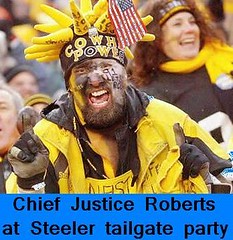
Supreme Court Justices to Don Steelers Black & Gold Robes & Terrible Towels

"WASHINGTON - In a marked departure from his predecessor, Chief Justice John Roberts announced that the Court will allow advertisements on its Justices' robes, but not for any person or business that currently has a case pending before the Court. The first ads, fittingly enough on the Friday before the AFC Championship, will be for the Pittsburgh Steelers. Roberts declared Friday "Black and Gold Day" at the United States Supreme Court. All justices will don ceremonial Terrible Towels over the traditional black robes worn since the inception of the court over two hundred years ago."

Read more in this post from The Carbolic Smoke Ball.

How to Make an Effective Presentation

This Business Opportunities Weblog post refers to a post by Guy Kawasaki offering the following advice on how to get a standing ovation at your next presentation:

"Have something interesting to say.
Cut the sales pitch.
Focus on entertaining. Understand the audience.
Overdress.
Don't denigrate the competition.
Tell stories.
Pre-circulate with the audience.
Speak at the start of an event.
Ask for a small room.
Practice and speak all the time. "

Networking 101 for the CIO

"While CIOs are masters of a variety of skills, networking typically isn’t one of them. Most CIOs, introverts at heart, would rather lead a global SAP deployment than work the room...Yet, effective networking is often a means toward better business partners, better employees and better jobs...These four IT executives offer practical, tactical advice for identifying the most promising networking opportunities and making the most of them.

1. Avoid generic networking events. Dave Clarke, CTO of the American Red Cross...
2. Conceptualize and build a networking model. Greg Smith, CIO of the World Wildlife Fund..,
3. Focus on vertical networking. Chris Feola, CIO of AskSam Systems...
4. Take an MBA short course....
5. Engage in collaborative networking. Tom Morgan, CIO of Dobson Communications..."

Read more in this article by Martha Heller for CIO.com

1/19/2006

Free Management Library

Carter McNamara of Authenticity Consulting, LLC offers an integrated Management Library for For-Profit and Nonprofit Organizations at http://www.managementhelp.org containing 75 popular categories of topics.

List of Popular Web 2.0 Applications

Virtual Karma provides "an alphabetically sorted list of popular Web 2.0 applications. The description for each of the application is taken from their own About or FAQ pages."

1/18/2006

Love the Work You're With

Snippets from an excellent article by Paul Graham:

"Doing what you love is complicated. The very idea is foreign to what most of us learn as kids…

Prestige is like a powerful magnet that warps even your beliefs about what you enjoy. It causes you to work not on what you like, but what you'd like to like… Prestige is just fossilized inspiration. If you do anything well enough, you'll make it prestigious… So just do what you like, and let prestige take care of itself.

Prestige is so effective at distracting the ambitious that society has evolved many ways to use it for this purpose. If you want to make ambitious people waste their time on errands, the way to do it is to bait the hook with prestige. That's the recipe for getting people to give talks, write forewords, serve on committees, be department heads, and so on. This pattern is so common that it might be a good rule simply to avoid any prestigious task. If it didn't suck, they wouldn't have had to make it prestigious….

The other big force leading people astray is money… With such powerful forces leading us astray, it's not surprising we find it so hard to discover what we like to work on. Most people are doomed in childhood by accepting the axiom that work = pain. Those who escape this are nearly all lured onto the rocks by prestige or money. How many even discover something they love to work on? A few hundred thousand, perhaps, out of billions.

That's an important thing to bear in mind. It's very hard to find work you love. It must be, if so few do. So don't underestimate this task. And don't feel bad if you haven't succeeded yet. It's not a sign there's something wrong with you if you have trouble finding the work you love, any more than it is if you're out of breath climbing a 30% grade. In fact, if you admit to yourself that you're discontented, you're a step ahead of most people, who are still in denial...

You tend to become what you do. If you work on tedious stuff for too long, it will rot your brain…The kid who wants to write but decides to go to law school, thinking that he'll be a lawyer and write in his spare time, runs a great risk of finding ten years later that he has become a lawyer…

In the design of careers, as in the design of most other things, you get better results if you use flexible media. Unless you're fairly sure what you want to do, your best bet may be to choose a type of work that will allow you to delay deciding…

The only way to learn what a job is really like is to do it. So a job that lets you work at many different things is good not just because you can push it in many different directions, but because you can learn faster which direction you want to push it in…

If you work hard at being a bond trader for ten years, thinking that you'll quit and write novels when you have enough money, what happens when you quit and then discover that you don't actually like writing novels?...

Constraints give your life shape. Remove all constraints and most people have no idea what to do: look at what happens to those who win lotteries or inherit money. Much as everyone thinks they want financial security, the happiest people are not those who have it, but those who like what they do..."

1/17/2006

Guide to Retail Business Startup

Whether you want to sell the latest fashions or coolest toys, hardware or pet accessories, sporting goods or beauty supplies, you may wish to begin your journey at the Retail Startup Center from Entrepreneur.com The site allows you to get started with extensive how-to, then check out numerous articles on retail trends, successful business owners, tips, tactics and more.

Technorati Tags: , , ,

Practicing Servant-Leadership

"Since the time of the Industrial Revolution, managers have tended to view people as tools, while organizations have considered workers as cogs in a machine. In the past few decades we have witnessed a shift in that long-held view. In countless for-profit and nonprofit organizations today we are seeing traditional, autocratic, and hierarchical modes of leadership yielding to a different way of working--one based on teamwork and community, one that seeks to involve others in decision making, one strongly based in ethical and caring behavior, and one that is attempting to enhance the personal growth of people while improving the caring and quality of our many institutions..."

Read more in this summary of servant-leadership principles found via this post from the Servant Leadership Blog.

1/15/2006

Audio Conversation One of Top Ten

I am pleased to report that this interview of Anthony Cerminaro regarding the "Well Utilized Business Lawyer" was selected as an SMB Trend Wire|Top Ten Most Requested Small Biz Audio. In the audio conversation, I discuss with Anita Campbell and Steve Rucinsky legal issues important to small businesses and how and when to make effective use of a business lawyer as part of "the team."

Aim for Sustainable Competitive Advantage

"A common approach used by investors to identify potentially successful businesses and to minimize risk is to judge a business on its ability to achieve and perpetuate a sustainable competitive advantage. Some of the characteristics that can provide such an advantage include:

+Unique technology or processes (yielding products or services that can be shown will be in high demand by the marketplace).

+Intellectual property protection (patents, trademarks and copyrights that can be realistically defended).

+Human-resource factors (expertise and track record in a proven management team).

+Strategic alliances with key market players (unique partnerships, joint ventures and/or exclusive licenses that are equally beneficial for all parties).

+Location (ownership or favorable long-term lease of property with unique market attributes).

+Marketing/distribution (unique branding and/or distribution rights that will lead to a sustainable and powerful image)."

From an article in the OrlandoSentinel.

1/13/2006

Technology Aids Entrepreneurs in Middle Income Countries

"Entrepreneurs in middle income countries are beginning to catch-up to their counterparts in richer economies by tapping into technologies unavailable to them just a year ago, according to the seventh annual Global Entrepreneurship Monitor (GEM). Directed by Babson College and London Business School, the report is the largest annual measure of entrepreneurial activity worldwide, compiled by more than 150 scholars from 35 countries.

GEM 2005 also found that entrepreneurs with 'innovative' businesses drive higher growth rates of GDP per capita. Additionally, middle income countries tend to start more businesses than high income countries. Yet 'quantity' of start-ups does not necessarily translate into 'established' businesses..."

Read more in this Babson College press release.

Guide to Winning Friends & Influencing People

"This guide to the ideas in Dale Carnegie's How to Win Friends and Influence People highlights the core ideas of the book in outline format. The guide and the book are intended to help you build more effective relationships and motivate others. The guide identifies these as the three fundamental tenets repeated throughout the book:

Never criticize, condemn or complain.
Self-criticism is extremely rare. Your criticism won’t be welcome.
Criticism makes others defensive and resentful.
Positive reinforcement works better.

Make the other person feel important.
People deeply desire to feel important and appreciated.
Praise others’ strengths and they’ll strive to reinforce your opinion.

Frame requests in terms of what motivates others.
Ask yourself: “Why should someone want to do as I ask?”

1/12/2006

Gathering Competitive Intelligence

"The most important distinguishing feature of successful companies is how they monitor and respond to events and conditions in the
environment in which they operate. Unless you notice what is happening, you will blunder along in the dark, not knowing where you are going, what your competitors are doing, or what business opportunities are passing you by.

Enter competitive intelligence: a systematic and ethical programme for gathering, analysing, and managing information about your business environment that can affect your company's plans, decisions, and operations.

The potential benefits of implementing a CI programme are many. Timely intelligence will help you to anticipate and minimise risk, identify business opportunities and new markets, make sound decisions, innovate, improve your strategic planning, and allocate your resources more effectively. Intelligence operations are not a form of spying; they may (indeed, should) be conducted both legally and ethically. They can be set up with little cost, carry little risk, and are easily concealed..."

Read more in this article from FreePint.

Technorati Tags: , , ,

When Should You Sell Your Tech Business?

This post from Seth Levine identifies two peak times for the sale of a software/technology business. The first is the point when the technology has been proven, just before the company enters into "what Gartner would call the trough of disillusionment but what entrepreneurs would more likely call the long hard slog." The second optimum sale point would be upon emerging from slog, when "you now have real critical mass and market validation/adoption. Your revenues are well into the double digits and you’re probably cash flow positive even as you re-invest in your business to keep your growth up."

Technorati Tags: , , , ,

Getting Rid of Spyware

"Spyware is one of the most challenging — and frustrating — problems faced by today's computer users and administrators. Even the savviest Internet surfers have discovered their systems are riddled with unwanted software that display popup ads, modify their search engines or home pages, slow down performance or even make the system unstable."

If you suspect that your system is infected with adware, spyware, or other malware, check out this article from information week for instructions on how to get rid of it.

Found viathis WisBlawg post.

Technorati Tags: , , ,

1/11/2006

Five Ways to Raise $100,000

"They key points to remember when you're looking for funds to start your own business are:

Make sure your business plan is well thought out, well presented and, most of all, realistic.
Most sources of funding, whether it's friends and family, banks, venture capital companies or a Business Angel, will want to see that you're taking on some of the risk yourself. Nobody wants to feel that it's only them that are at risk of losing their investment.
Spread your debt around between a number of sources. The more people you can get involved in your business, the more advice and expertise you can call on, and there's always the possibility of extra funding if your business does well.
You may have to sell a stake in your business to secure the funding you need. Don't be afraid to go down the 'Dragon's Den' route of funding. If your creditors have a stake in the venture, they're much more likely to help you out of trouble than see their investment disappear.
Most of all, if you believe you have a good idea then make something of it. Don't give up..."

Read more in this post from MSN Money UK.
'."

Technorati Tags: , , , ,

1/10/2006

Risks & Reward of Franchising

"There are several very good reasons to pursue a franchise as a first time entrepreneur.

First, most franchises have a business model already in place that has been tested and refined...Second, the systems should be well established and ready to go...Third, a franchisor should be able to provide significant help in marketing...Fourth,...a franchise eliminates the need to come up with an original, creative business opportunity...

With all of these advantages, there are several sobering disadvantages of franchising...Beyond the contractual issues that arise in franchising...over time, many franchisors realize that they can be just if not more effective on their own without paying the monthly percentage of sales to the franchisor...These on-going fees can eat away at profit margins if there is not real value added in what the franchisor provides.

Another concern expressed by franchisees is that with all of the rules and standardized procedures, they tend to feel more like an employee than a business owner...A financial risk to consider is that many first time entrepreneurs can only afford newer franchised concepts..All franchise opportunities are not created equal."

Read more in this excellent article from the Entrepreneurial Mind.

Technorati Tags: , ,

2005 Movies in Review

This is an updated list of 2005 movies I have seen. Four star movies are those that I highly recommend. Expertly crafted, captivating stories, well acted, haunting, amazing. If not masterpieces, then pretty close. My favorites.

Three and half star movies are just a smidge below, maybe missing one of the foregoing elements. Greatly entertaining, highly superior movies. Also strongly recommended.

Three star movies are those just below the foregoing. Worth seeing, worth a trip to the theater. Recommended.


**** Four Stars (Very Highly Recommended)

Capote
Walk the Line
Syriana
The Chronicles of Narnia: The Lion, the Witch and the Wardrobe
Munich

***1/2 Three Point Five Stars (Highly Recommended)

Good Night and Good Luck
Pride and Prejudice
Batman Begins
June Bug
Sin City
Crash
Cinderella Man
The Constant Gardener
Wallace & Gromit: The Curse of the Were-Rabbit
Breakfast on Pluto
The Corpse Bride
A History of Violence
Match Point

*** Three Stars (Recommended)

The Wild Parrots of Telegraph Hill
Jarhead
Millions
Harry Potter and the Goblet of Fire
The Hitchhiker's Guide to the Galaxy
Star Wars: Revenge of the Sith
Me and You and Everyone We Know
March of the Penguins
Hustle & Flow
Broken Flowers
Proof
Lord of War
Everything is Illuminated
Serenity
Shopgirl
The Weather Man
Rent

**1/2 Two Point Five Stars (Mixed Bag)

Brokeback Mountain
King Kong
North Country
Charlie and the Chocolate Factory
The Wedding Crashers
The 40 Year-old Virgin
Dreamer: Inspired by a True Story
Sahara
Flightplan
Chicken Little
Sky High

Technorati Tags:

Free Complete Toolkit for Boards

This virtual library designed by Carter McNamara, MBA, PhD provides a bonanza of resources for board members, those contemplating serving on a board, or companies organizing or working with an existing board of directors, stating:

"Corporations, whether for-profit or nonprofit, require a governing Board of Directors. Governing Boards have certain legally required duties, including duties of care, loyalty and obedience... Some people believe in life stages of Boards, including that they 1) start out as "working" Boards where members focus on day-to-day matters in addition to strategic matters, 2) evolve to "policy" Boards where members focus mostly on strategic matters, and 3) eventually become large, institutionalized Boards that often have small executive committees and maybe many members some of which are "big names" to gain credibility with funders or investors.

Boards can have a broad range of "personalities." For example, Boards of large for-profit and nonprofit corporations might be very formal in nature with strong attention to Parliamentary procedures, highly proceduralized operations, etc. In contrast, Boards of small for-profit, family-owned corporations might be very informal in nature and comprised mostly of members of the family, rather than of independent members (members from outside of the family and/or corporation)...

Recent illegal activities, particularly in large, for-profit corporations, have brought much attention to the roles and responsibilities of Boards, especially to their degree of effective oversight ("oversight" as in ensuring strong, effective organizations), ethical operations and approach to compensating senior executives..."

Technorati Tags: , , , ,

1/09/2006

Lakota Instructions for Living

"Friend do it this way - that is,
whatever you do in life,
do the very best you can
with both your heart and mind.

And if you do it that way,
the Power Of The Universe
will come to your assistance,
if your heart and mind are in Unity..."

Read more in this post from conscious living journal.

FactSheets from Barclays Business Banking

The Barclays Business Information Factsheets Service provides concise but comprehensive information on various aspects of running a business. Below are examples of the type of information provided:

1. A guide to writing a Business Plan
2. A guide to renting premises for your business
3. Could you run your own business?
4. A checklist for financing a new business
5. How to forecast cash flow

Technorati Tags: , ,

Reading Between VC Lines

This post by Guy Kawasaki explains how to understand what a venture capitalist is really saying. For instance, at to whether a VC is interested in investing in your company, each of the following means "No":

'I liked your company, but my partners didn't.'
'If you get a lead [investor], we will follow.'
'Show us some traction, and we'll invest.'

Technorati Tags: , , ,

1/08/2006

Technology Trends for 2006

See this post by Manav Sehgall the provides links to 9 different sources of technology predictions for 2006. Common themes include security, offshoring debate, Web 2.0, Year of the Blog and Software as a Service.

Technorati Tags:

Open Source to the Rescue

"The traditional enterprise software business model is broken. A rabid search for new customers and revenue growth has caused sales and marketing costs to spiral out of control...

This quest for additional revenue has created an untenable cost structure for the industry - one that doesn't serve vendors or their customers. In essence, vendors spend a lot of money to convince customers to buy, and then charge them a lot of money for the license which covers the sales and marketing costs. We're charging the customer just to sell to them.

Enter Open Source..."

Read more in this SandHill.com article.

Technorati Tags: , ,

States Add Laws on Data Breaches

"Companies struggling to keep up with a patchwork of state laws related to data privacy and information security have three more to contend with, as new security-breach notification laws went into effect in Illinois, Louisiana and New Jersey on Jan. 1.
Like existing statutes in more than 20 other states, the new laws prescribe various actions that companies are required to take in the event of a security breach involving the compromise of personal data about their customers...

For companies that do business nationally or in various states, the smorgasbord of state laws poses a growing problem, because the measures often specify different triggers for notifications and set varying requirements on what needs to be disclosed, to whom and when..."

Read more in this article from Computerworld found via this post from Gahtan's Technology and Internet Law Blog.

1/07/2006

ESOP No Fable, but Viable Exit Stratgy

"One of the great ironies of entrepreneurship is that many people spend years building their companies, only to undo all of that work at the very end by deciding to sell the business to the wrong person. Decisions like that don't have to be made, especially today. Employee stock ownership plans, or ESOPs, have become a mainstream alternative for business owners who wish to sell their business but want it to remain largely intact...

Legally, an esop is a tax-qualified retirement plan. It borrows money to buy the owner's shares, then allocates them to employee retirement accounts as the loan is paid off. In certain circumstances the selling shareholders can defer capital gains taxes...

But selling to the employees? Will the inmates be running the asylum?

The legalities are clear and reassuring to nervous managers. The business runs as usual, with the CEO and the board in charge. The ESOP shares' votes are in the hands of a trustee, who is appointed by the board, just like the CEO. What's not so clear are people's expectations...

One key to success is educating employees about what it means to be an owner. Yes, you will benefit in a major way if the company makes money and grows; here's how. No, you don't get to tell your boss what to do, and no, you aren't automatically entitled to know what she makes..."

Read more The Ultimate Employee Buy-in from Inc.com.

Cool Photos from the Pittsurgh Flickr Pool


slopes
Originally uploaded by sharwest.


Terabull Tahls
Originally uploaded by UrbanTiki.
Just some of the photographs recently posted to the Pittsburgh, PA Pool on Flickr.


The Morning's Best View
Originally uploaded by btezra.

Licensing University Technology

"What do Yamaha synthesizers, gene splicing and DSL have in common? They are all based on technology licensed from universities. As these examples show, universities often develop and license new cutting edge technologies. In this brochure [from Fenwick & West via Mondaq], we will walk you through the process of determining whether a university license may be right for you, how to obtain a university license, and the deal terms you can expect to find in a university license."

1/05/2006

Venture Capital Conferences Directory

"The world of venture capital is built on relationships that foster ideas into actions. Conferences and discussion forums are, without a doubt, ideal environments in which these partnerships are born and developed. Venture Capital Conferences brings together a comprehensive online database focused on venture capital and emerging technologies events in America."

Business Planning Links

"This library of resources [from Business Resource Software] contains links to hundreds of sites offering research materials on every area of planning a business including: venture capital, new products, market analysis, competitive analysis, production management, tax problems, legal issues, financial statements, writing a business plan and much more."

1/04/2006

Stress Busters for the New Year

"Set Realistic Goals...

Use the Power of Positive Self-talk
The best way to eradicate those "weeds" that fill the "garden" of your subconscious mind is to practice telling yourself positive, self-enhancing thoughts every time you catch yourself being negative...You can re-program your subconscious by recognizing your negative, self-defeating thinking patterns...and changing them on the spot....

Choose an Optimistic Interpretation of Events...

Change Your Diet and Exercise Habits...

Embrace Opportunities for Relaxation...
One of the best stress busters is regular relaxation breaks. These can range from spontaneous mini-vacations (e.g., weekends), to a relaxing walk in a serene place (e.g., the beach or near a babbling brook), to taking 15 minutes twice a day to meditate right in your office. There are many excellent relaxation tapes, yoga exercises, and visualization/hypnosis tapes on the market. The key to this is to make the time, be sure you will not be interrupted and stick to your plan. Recharging your emotional batteries is healthy and easy to do, as long as you take charge of yourself to allot the time and make relaxation part of your weekly routine.

Stay Close to Positive People and Influences
Unfortunately, many of us are married to, related to, or work for negative, pessimistic people. These are folks who have their own fears of change, do not take risks, and wallow in their own misery. These members of the "negativity club" want you to join them, because that helps them to justify their own behavior and ideas...So, be a "Teflon" person...let the comments of these folks bounce off you...Find positive, optimistic, successful people to get close to, who will encourage you to move away from your habitual, "inside of the box" ideas. What a breath of fresh air that will feel like to you!

Search for Opportunities for Fun and Laughter..
Bringing fun into your life is immensely important for your health. Endorphins, which override stress hormones and produce a sense of release and calm, are released by the brain every time we laugh or engage in a fun activity. In fact, the immune system is impacted in a powerful way by fun and laughter...

Read more in this article by Dr. Jack Singer.

1/03/2006

Advice & Resources for College Entrepreneurs

From this article from Quintessential Careers:

"The most common piece of advice among experts on collegiate entrepreneurism seems to be -- just do it. Don't wait too long to launch your business. Don't make excuses for why it won't work or why you can't do it. Don't let fear, lack of money, insufficient time, or other obstacles stand in your way. Even if you fail, you still will have gained a great learning experience."

Other tips from the article:

"Be a problem-solver. Find a need or a niche and demonstrate that your idea can fill it. Do your homework so you truly understand the market into which your product or service falls.

Gain exposure to others who have started successful businesses, especially other college students and recent grads who can inspire and motivate you.

Be innovative. Hone your idea by sharing knowledge and brainstorming with other college students.

Network and get a mentor...

Take on extracurricular leadership roles to gain management practice and consider working at an entrepreneurial company to attain practical experience...

Speak with confidence and contagious enthusiasm when you tell others about your business idea -- especially when you tell investors -- but don't be too cocky...

Start your business and get class credit, too..."

And to help you along in your endeavors, check out this excellent collection of Resources for College Entrepreneurs.

Guide to Startup Forecasting

"Forecasting business revenue and expenses during the startup stage is really more art than science. Many entrepreneurs complain that building forecasts with any degree of accuracy takes a lot of time--time that could be spent selling rather than planning. But few investors will put money in your business if you're unable to provide a set of thoughtful forecasts. More important, proper financial forecasts will help you develop operational and staffing plans that will help make your business a success."

This article by Asheesh Advani provides some detail on how to go about building financial forecasts when you're just getting your business off the ground.

1/02/2006

VC Presentation 10/20/30 Rule

"It’s quite simple: a PowerPoint presentation should have ten slides, last no more than twenty minutes, and contain no font smaller than thirty points...

Ten is the optimal number of slides in a PowerPoint presentation because a normal human being cannot comprehend more than ten concepts in a meeting...If you must use more than ten slides to explain your business, you probably don’t have a business.

The ten topics that a venture capitalist cares about are:

1. Problem
2. Your solution
3. Business model
4. Underlying magic/technology
5. Marketing and sales
6. Competition
7. Team
8. Projections and milestones
9. Status and timeline
10. Summary and call to action

Read more in this post by Guy Kawasaki. For another perspective on what a VC presentation should include, see this Brad Feld post where he identifies the following questions as being necessary to answer:

1) What is your vision?
2) What is your market opportunity and how big is it?
3) Describe your product/service
4) Who are your customers?
5) What is your value proposition?
6) How do you sell?
7) How do you acquire customers?
8) Who is your management team?
9) What is your revenue model?
10) At what stage of development are you?
11) What are your plans for fund raising?
12) Who is your competition?
13) What partnerships do you have?
14) How do you fit with the prospective investor?
15) Other
- What assumptions are key to the success of the business?
- What "gotchas" could change the business overnight? New technologies, new market entrants, change in standards or regulations?
- What are your company’s weak links?

Habitat for Humanity Bicycle Challenge


uphill
Originally uploaded by TigerTigerTiger.
My daughter is one of the student leaders organizing the Habitat for Humanity Bicycle Challenge for 2006.

She and 89 other college students, in an epic effort to raise awareness and money for Habitat for Humanity, will saddle up and spend this summer biking 4,000 miles across North America.

Every night, the riders will give presentations and answer questions in churches and community centers, trying to increase Habitat's visibility, stimulate the formation of new chapters, and encourage donations.

To make HBC 2006 a success, the riders need your help! Please take a moment to browse through a list of frequently asked questions and their answers, and check out some more information about the Bike Challenge.

If you like what you see, consider raising money and awareness by biking coast-to-coast for Habitat (applications posted soon), donating to the trip, or becoming a corporate sponsor.

Since each rider is required to raise $4,000 to go on the trip, if you decide to donate, please include my daughter's name, Deirdre Cerminaro, so that she may receive credit for your kind contribution.

Finally, the riders are specifically in need of a corporate donation of three digital projectors to use each evening to make their presentations. Please contact me if you or someone you know would be interested in donating them.

New Years Wishes

New Years wishes from Ed Morrison:

May we see a world next year in which more children are safe and healthy, more adults do good work, and each of us are connected with more ties of understanding and compassion.

Via this Brewed Fresh Daily post.

1/01/2006

Starting a Small Business Articles

This post from lifehack.org provides links to three articles by Jerry Glenn at the Entrepreneur Network on how to start a small business. The articles provide information on selecting a business to start, choosing the type of business organization, how to raise money for your small business and writing a business plan.

Links to Entrepreneurial Resources

"Entrepreneurial Resources (EntrepreneurialResources.info) is a Subject Tracer Information Blog developed and created by the Virtual Private Library. It is designed to bring together the latest resources and sources on an ongoing basis from the Internet for entrepreneur resources...This site has been developed and maintained by Marcus P. Zillman"