10/24/2006

What Holds You Back? Examine Your Core Beliefs

"Brenda has always wanted to have her own business. She's had numerous innovative ideas for new ventures, so many that her friends have dubbed her 'the idea lady'. Trouble is, each time she considers putting one of her ideas into action, her mind automatically goes to either 'Most small businesses fail in the first few years' or 'I don't have enough business education to manage it correctly' or 'I don't have enough capital to make it happen, and what bank is going to give me a loan?'

Brenda stops herself from acting before she even begins. Her heart is telling her that having her own business would express her potential and be a joyous, fulfilling experience, but she pulls back every time.

She can't even consider taking a business course to bone up on her skills, or doing some market testing, or having someone help her write a business plan so she can present it to a potential investor. She can't get this far, because her erroneous core beliefs arrest any further consideration...

No matter how long these erroneous core belief have been with us, no matter how deeply implanted they are in our subconscious, they can be uprooted. The process of uprooting begins with identifying the erroneous core beliefs as mere perceptions, then discovering the truth which is hidden behind them...

We live in a world that repeatedly tells us...life is a crap shoot, and most businesses and marriages fail. It tells us that only a few individuals have the power and it's those who will ultimately determine our fate. It tells us we need to aggressively compete with each other in order to win in the game of life. It tells us to grab for what we can, because there's not enough to go around. This world tells us to fear our neighbors and to be suspicious of everyone we meet.

No wonder we're terrified of trying anything new, be it a relationship or career change... We have accepted these pernicious lies for so long they have become our reality...

[A]way of discovering our core beliefs is to examine the attitudes or feelings we have about certain situations. Often, this is where our core beliefs are reflected. The following are examples of some common human attitudes and the limiting core beliefs which may be reflected in them. After the core belief is revealed, a statement of Authentic Truth is
offered...

Attitude: 'Look at the rude guy driving that expensive car. Does he think he owns the entire road? Who does he think he is? Why can't I have a cool car like that? I'll bet he cheats people to make his money.'

Possible Core Beliefs: The Universe isn't fair because it makes it easy for some to get what they want and tough for me. Rich people are rude. You have to be ruthless to make money. Therefore, I'll never get what I want unless I compromise my values.

Authentic Truth:...If this individual can manifest a beautiful car, then so can I. The same principle that brought it to him will bring it to me. Therefore, I can be happy for this person. Also, I know that many people make money doing worthwhile things. If they can do it, so can I...

Attitude: 'I hate this job. They don't appreciate me. I work too hard -- and for what? I'm too talented/smart for this. I'm bored, but I can't leave because I need the insurance, got to pay my bills, need the steady paycheck, etc. Also, the economy is so bad right now, no one is hiring.'

Possible Core Belief: The Universe is limited. I'm not being taken care of. There's too much competition. Doing what I love doesn't pay the bills. I'm too old, didn't get the right education, didn't follow the correct career path, am not smart enough, not motivated enough, etc., etc. I don't have what it takes to succeed.

Authentic Truth:...I was created as a magnificent, intelligent, and talented individual with a unique gift to give this world. It is natural for me to be fulfilled, satisfied, successful and happy...I am open, and am being guided, to new opportunities which are unfolding in my life right now...

Remember you have dominion over the core beliefs that occupy your mind and you have the power to change them!"

Quoted from the book Mastering Your Desires ©1998, by Victoria Loveland-Coen, founder of Self Mastery Press. For more information visit Journey Toward Selfmastery.

Technorati Tags: , , , ,

10/22/2006

Useful Startup Questions...and Documents

Jeffrey Stewart provides 180 Useful Questions for Launching a Business that also includes this:

"List of Useful Documents, Charts and Models for Launching Businesses

• Business Plan
• Business PowerPoint
• Branding Standards
• Projected Balance Sheet
• Break-even Analysis
• Projected Income Statements
• Cash Flow Projections
• Team and Advisor resumes
• Customer Sponsor bio
• Open Job descriptions
• Sales PowerPoint
• Letters of Intent
• Projected Organizational Chart (by quarter)
• New Hire Orientation Packet/Presentation
• Intellectual Property Protection Plan
• Press Kit
• Product Specifications
• Product Road Map
• Competitive Analysis
• Related Reading list
• Funding Plan"

Stand Out in a Crowd

"How do you set yourself apart from the competition?...The key to making your mark is to:

Acquire powerful allies – people in high places that believe in you and your product...
Create an angle – whether it’s a David and Goliath story or a ‘first’...
Know your customers...
Have a plan – have goals set out, long and short term, where you can gauge your success...
Always talk about it...In every conversation at every chance talk about your business and your goals..."

Read more in the post from Mind Petals: Young Entrepreneur Network.

10/19/2006

Employers Must Battle Identity Theft Threat

"Identity theft is not only a growing problem for consumers across the country, but it is clearly a growing danger for the unwary employer as well."

So states John Emerson in this excellent article from Nexsen Pruet. Attorney Emerson offers these suggestions for reducing the risk of liability related to the theft of employee personal information:

"First, employers should carefully consider how much information is actually required for each employee...

Second, employers should ensure that sensitive information is stored in well-secured files with limited access...Files containing personal data should not be stored on a central network accessible by all employees.

Third, employers should take simple though often overlooked steps such as locking file cabinets, deleting social security numbers from personal files...and ensuring that fax machines and mail depositories are in secure locations.

Fourth, employers should conduct training sessions...

Finally, in addition to the selfimposed changes employers can implement to improve information security, employers should know that, under Federal Trade Commission Regulation, consumer information that is contained in or derived from a consumer report must be disposed of in a very specific manner..."

Found via the Employment Law Information Network newsletter.

10/18/2006

Take Risks But Don’t Cut Corners

"Entrepreneurs take risks all the time. It’s just part of running a business. There’s almost no such thing as a business that runs with no risk. So entrepreneurs are aware of, and often comfortable with taking risks.

But cutting corners is a different story.

Cutting corners is doing things less than your best to achieve some end goal. It’s usually not a good idea. It may feel like you’re making progress by cutting corners, but at the end of the day you’re not. You’re not building up enough value in your business, for the long haul, when you start to cut corners.

It’s important to recognize the differences between legitimate risks and cutting corners. Risks need to be assessed on a number of factors: probability, impact, reward. Risks need to be clearly identified so that they can be managed and treated. Cutting a corner is a form of risk, but it’s a silly one to take. More often than not if you really assess the significance of the risk and reward of cutting a corner, you’d realize it’s not worth it."

Read more in this post from Instigator Blog.

10/17/2006

Podcasts for Technology Entrepreneurs

"Northeastern University has a collection of podcasts on entrepreneurship. The focus is more on technology entrepreneurs than non-tech. I'm not a podcast person, but if you are into them, check it out."

See this Businesspundit post, from which the foregoing was quoted, for a link to the podcasts.

10/16/2006

Naming Your Business

"There's a lot of room for personal and professional creativity when choosing a business name, but there are three main considerations to keep in mind:

Will your business name receive trademark protection?

Is your proposed business name available?

If your business will have a website, is a similar domain name available?"

So states this article from nolo.com that offers these additional guidelines:

"Make your name memorable. A creative, distinctive name will not only be entitled to a high level of trademark protection, but it will also stick in the minds of your customers...

Your name should be appealing and easy to use. Choose a name that's easy to spell and pronounce, and that is appealing to both eye and ear...

Avoid geographical names...especially if you plan to sell products on the Internet...

Don't...choose a name that might not be representative of future product or service lines...

Get feedback. Before you settle on a name, get some feedback from potential customers, suppliers and others in your support network..."

10/15/2006

The CEO as Startup Coach

"You cannot just be a CEO, focused on executing your business plan and keeping your investors happy. You must also be a coach for your team.

Think about it. Coaches motivate their teams before, during and after games. You are now the coach of your team and you need to be sure your team is correctly motivated through both the good and bad times. To do this, you, like any other coach will need a game plan..."

Read more in this post from A VC in Vacationland.

Negotiating a Technology Executive Employment Contract

"There are 10 critical areas that executive candidates and software companies should consider negotiable. During negotiations, issues in these areas need to be raised, discussed, and resolved to assure that both parties are being treated fairly...The resulting employment contract should reflect the above-board style and approach of both parties and lay a foundation conducive to getting the best for all concerned."

So states this article by Robert Adelman that offers valuable insights into the executive's perspective versus typical company realities regarding the following topics of negotiation:

1. Signing bonus
2. Meaningful Equity
3. Tax-favored Equity
4. Relocation Assistance
5. Position, Duties, Support
6. Expense Payments
7. Non-Compete and Non-Disclosure Agreements
8. Term/Termination
9. Reasonable Severance
10. Good Vibrations

10/12/2006

Intellectual Property Nuts and Bolts

Here are links to resources that provide basic information about patents, trademarks, copyrights and trade secrets that I am sharing with the students in the entrepreneurship class I am teaching this semester. I thought I would share them with you as well.

Intellectual Property Primer from Sitepoint.com

Trademarks 101 from About.com

Guide To Patents from About.com

Copyright Basics from the U.S. Copyright Office

Trade Secret Basics FAQ from Nolo.com


Technorati Tags: , , , ,

10/05/2006

Questions Founders Should Ask Each Other

"The following are some of the most important questions that should be resolved as early in the [startup] process as possible. In most cases, these issues only get more difficult over time...

1... Who gets what percentage of the company?...(and the right answer is rarely “divide them equally amongst the co-founders”).

2. How will decisions get made?...Common areas to address are decisions around capitalization, executive hiring/firing, share issuance (dilution) and M&A...

3. What happens if one of us leaves the company?...The last thing the company needs is a co-founder that is no longer engaged but is hanging around out of guilt or ambiguity.

4. Can any of us be fired? By whom? For what reasons?...

5. What are our personal goals for the startup?...

6. Will this be the primary activity for each of us?...

7. What part of our plan are we each unwilling to change?...

8. What contractual terms will each of us sign with the company?...

9. Will any of us be investing cash in the company? If so, how is this treated?...

10. What will we pay ourselves? Who gets to change this in the future?..."

Read more in this excellent post from onstartups.com.

Competitive Advantage Interactive Workshop

SCORE "Counselors to America's Small Business" offers this fun and informative interactive workshop on Creating a Competitive Advantage that is well worth a look.

Included in the presentations are a series of competitive advantage worksheets that provide useful questions and suggestions including the following:

"The following questions are designed to help you determine whether you have an identifiable competitive edge and whether you are currently capitalizing on it:

1. Have I clearly defined my company and my target market?

2. Who are my competitors?

3. What is my company's specific strategy for success?

4. Do I regularly track my competitors' moves?...?

9. Does my company possess a uniqueness that easily separates it from my competitors? What, specifically, is it?...

16. What trends do I see for my industry in the future? Is my company – and my product mix – aligned with those trends?...

Ask yourself the following questions about your product or service:

1. Does my product perform?

2. Is it durable?

3. Is it reliable?

4. Is it fairly priced?

5. Does it consistently live up to its reputation?

6. Am I known in my industry for producing quality goods/services?

7. Does my product have brand recognition?

8. Can I create ways to ensure that my product/service is in demand?

9. Is my product a trendsetter?

10. Can I think of innovative ways to encourage more people to buy my product?

11. Can I market companion products/services?

Marketing Strategies

In devising your plan, keep in mind the following:

Ask yourself what the primary goal of your marketing strategy will be: Increased sales? Better brand-name recognition? A public relations effort?

Remember to whom you are selling and keep your message targeted

Focus on your product's or service's benefits rather than features

Don't be afraid to tout your successes

Be sure your plan is attainable

Perform a detailed market analysis (obtain pertinent demographic facts, figures and other relevant data) before you put your plan into action

Have a back-up strategy in mind, especially if your primary one is risky..."

Technorati Tags: , , , ,

10/04/2006

Exporting Tips

"A smart organization...will invest time and money building the proper administrative and sales structure before they begin [export] operations...

how to avoid major problems with your export business...

2. Create an export strategy before you begin to export. Don’t get sucked into exporting by “accident”...

4. Make everything perfectly clear with customers. Don’t assume anything, don’t work with suppositions.

5. Learn and understand the business culture of your export market and customers before you begin...

10. Use caution about exclusivity agreements. Everyone wants exclusivity, will that exclusivity support your entire export production? Will it limit your ability to grow?...

14. Create an export price strategy. Know where you are going, and how you want to get there, your costs and required profit margins before you begin to quote prices...

20. Discipline, planning and order. Production planning, raw material purchasing decisions, financing, infrastructure investment, human resources, sales and marketing all must be planned and coordinated, at all times.

Added Oct. 1, 2006 - Bonus legal reminder: Know the law of the country to which you are exporting concerning: retention of documents for litigation, product quality and manufacturing and product safety before you begin sales and shipping. Understand your responsibility and liability for recalls, retrofitting, refunds or destruction of the product. Learn about your legal responsibility and relationship with brokers, agents and distributors and your products."

Just a few of the useful pointers found in this Lee Iwan post that is well worth reading in its entirety.

Technorati Tags: , , , ,

9/26/2006

What to Do When You are Sued

This post from NFIB offers good advice on what to do when the process server enters your business, hands you some papers and declares, "You've been served."

"There are several acts that can bring advantageous results in responding to a lawsuit.

Do not ignore the lawsuit
The most important point is to never ignore the claim, no matter who makes it or where it comes from...If you fail to defend against a lawsuit in the time mandated by the law...you lose the lawsuit, even if good defenses to the claim exist.

Contact an attorney
Despite any fears toward lawyers, do not hesitate to get legal advice. Call your attorney, or if you don't have one, find one quickly...

Organize information
Generally, an attorney will ask a client to collect information for litigation. Gather all documents together in a logical order that the attorney can easily access. Don't destroy any documents, including e-mails or other electronic records, related to the case...Coordinate any investigation and data collection with your attorney...

Work with your attorney
Don't just turn the matter completely over to your attorney. Stay on top of the case and work closely with your attorney to make decisions on how to proceed...

Formulate a plan...
Your strategy for defense may depend on what you are willing or able to afford. Ask your attorney for an estimate on fees and expenses, and then determine your potential liability exposure with your lawyer based on how much the case could cost, what the chances of winning the lawsuit are, and how long the case may take. Decide on settlement possibilities and legal strategies, such as whether to countersue, using sound business judgment."


Technorati Tags: , , , ,

Conduct Effective Board Meetings

Pascal Levensohn makes available an excellent slide deck on conducting effective Board meetings and a link to a related post from Brad Feld on structuring board meeting agendas. The presentation is from a two hour seminar that Pascal recently moderated on Best Practices for Running a Board Meeting hosted by the law firm of Pillsbury Winthrop and is well worth reviewing.

Technorati Tags: , , , ,

9/25/2006

First of All, Let's Use a Lawyer

Lena Khorshid at MindPetals.com, the network site for young entrepreneurs, observes the following about the need for startups to engage legal counsel:

"Sometimes, I am stunned at how many entrepreneurs underestimate the value of competent legal counsel. They seem to do some sort of “weird math” that justifies subtracting legal fees only to add more money to the decorating budget...

In the long run, legal fees do add up. But, having competent legal counsel will save you money. I like to think of it as an expenditure with a concrete return on your investment.

For example, your lawyer will help you to negotiate favorable terms in your contracts; draft contracts that clearly reflect the terms of your business deal; and he/she can ensure that your contracts contain provisions that safeguard your revenue stream. In addition, your lawyer can apprise you of new developments in the law that can affect the operations and profitability of your business..."

A sentiment with which I must agree.

Read more at this Mind Petals post.

Technorati Tags: , , , ,

9/20/2006

Doing Good Through Social Entrepreneurship

Ashoka.org announces a new website that reflects its culture of innovation. The new site provides:

Easily navigable fellow profiles and increased search functionality
New information on Ashoka programs
Interactive maps to locate country information
A pressroom with the latest Ashoka news highlights and archives
Improved options for donor contributions
A comprehensive resource center on social entrepreneurship

"Ashoka is the global association of the world’s leading social entrepreneurs—men and women with system changing solutions for the world’s most urgent social problems. Since 1981, Ashoka has elected over 1,800 leading social entrepreneurs as Ashoka Fellows, providing them with living stipends, professional support, and access to a global network of peers in more than 60 countries.

Ashoka Fellows inspire others to adopt and spread their innovations—demonstrating to all citizens that they too have the potential to be powerful changemakers and make a positive difference in their communities.

By unleashing the same innovative and entrepreneurial mindset which has driven business sector growth over the last two centuries, Ashoka is leading a dramatic transformation in society, fueling the citizen sector’s unprecedented growth. With our global community of social entrepreneurs, Ashoka develops models for collaboration and designs infrastructure needed for this growth."

Technorati Tags: , , , ,

9/17/2006

Big Ideas in the Big Moo

From this Seth Godin post

"Griffin does a nice job of summarizing some of the big ideas in the Big Moo:

1. Real security comes from growth ( Page xiv ) To me this is the best statement in the book and it's right there in the preface.

2. Wanting growth and attaining growth are two different things ( Preface xv ) - Companies usually end up paralyzed by trying to focus on how they'll grow instead of actually growing.

3. Those who fit in now won't stand out later ( Page 5 ) - It's difficult to change once you get into a rhythm of mediocrity.

4. If you name something, you get power over it ( Page 18 ) - Ever try to change a bad nickname ? When a name catches on, it becomes very powerful.

5. Don't concentrate on making a standard. Once you create the standard, you've created a commodity and your customers will seek something like it, but cheaper ( Page 23 ) - *cough* Netscape *cough*

6. Being efficient is not as good as being robust ( Page 52 ) - There's such a thing as "good enough". Being flexible is better than trying to squeeze out a few extra performance cycles.

7. You can't predict the future ( Page 55 ) - ...

8. Everything is version .9, waiting for just one more upgrade before it's done ( Page 86 ) - Releasing something stable, but not complete is better than waiting it's "perfect". It will never be perfect.

9. Betting on change is always the safest bet ( Page 91 ) - You can't constrain change. People have scars from trying to.

10. Creativity is made up of iteration and juxtaposition ( Page 95 ) - Mash things together enough times, and something interesting will happen.

11. Compromise kills. Doing something half-ass is worse than doing nothing ( Page 97 ) - If you don't have enough information to implement something, ignore it and move on. It's better than trying to guess. Remember #7.

12. Novelty for the sake of novelty is risky and a recipe for irrelevance ( Page 100 ) - Solve a problem. I've written about this ...

13. The energy isn't in the idea, it's in the execution ( Page 101 ) - Everyone wants to sit around and think up cool stuff. Sooner or later, you're going to have to actually build something.

14. A product is what the customer thinks it is ( Page 131 ) - How many times have you gotten pissed at a user of your software for "using it wrong" ?

15. Don't let the seeds stop you from enjoying the watermelon ( Page 134 ) - The world is grey. Every solution, product, feature is the result of several trade-offs.

Technorati Tags: , , , ,

9/06/2006

Be an Authentic Leader

The following articles from BNET.com (with BNET's commentary) explain how to develop a more direct, authentic style of leadership as well as the obstacles you'll face along the way.

Gaining An Edge: Authentic Leadership Lessons
Authentic leadership is leadership that can be trusted; leadership that is, in fact, as it is represented. In the business environment, authentic leadership is a fundamental requirement for generating peak performance. Some companies can make money, even in the absence of authentic leadership, but they can't come close to realizing their full potential without it. The characteristics of an authentic organization are: a guiding vision, a value-driven organization, a powerful focus for delivering work, and respecting people by expecting their best.

Lessons in Authentic Leadership
Vision, organizational thinking, and the ability to deftly act on strategic intent are the critical elements needed to sustain a competitive advantage in today's marketplace. Assumptions, operating principles and worldviews are strikingly dissimilar across the several generations in today's workforce. Leadership, going forward, is not as much about telling as it is about hearing; not as much about knowing as it is about facilitating dialogue and inquiry; not as much about being in charge as it is about enabling the necessary capabilities and outcomes. This paper explores how authentic listening serves as an indispensable tool for leaders at all levels.

Mindfulness, Hope and Compassion: A Leader's Road Map to Renewal
How does a leader quell the everyday, inner conflicts caused by the heavy responsibility, the need for constant self-control and the inevitable crises - and still remain an effective leader? Not easily. These authors have excellent suggestions for calming and resolving that turmoil and for going beyond to remain an effective, highly resonant leader.

Becoming An Authentic Leader
Authentic leaders genuinely desire to serve others through their leadership. They are more interested in empowering the people they lead to make a difference than they are in power or prestige. They are as guided by qualities of the heart, by passion and compassion, as they are by qualities of the mind. The paper examines some characteristics of authentic leaders.

Rethinking Leadership Thinking: Choosing a More Authentic Path
Today, for the first time, leaders may find that authentic leadership and inspired teams are prerequisites to organizational survival. A rapidly changing world demands speed, flexibility, and responsiveness. Past systems of command and control, strict hierarchical structures, and dictated actions are inadequate to the task. To become a more effective leader of an inspired team, you have to unlearn many past practices, create a compelling value proposition for change and build a process that helps to anticipate and deal with resistance.

Technorati Tags: , , , ,

9/04/2006

FAQ on Starting a Solo Business

While there are hundreds of questions running through the mind of a solo entrepreneur at any given time, this this article from workingsolo.com does a good job of addressing these:

1. How can I tell if I've got what it takes to be a solo entrepreneur?
2. What are the most important things to do before a would-be entrepreneur he or she quits a day job?
3. What are the biggest challenges to starting a business?
4. How do you determine what kind of business is best for you?
5. What are the biggest mistakes new business owners make?
6. How much start-up capital does a typical small business need?
7. Are there any financial or tax advantages to starting a small business?
8. What are the best ways for a small business to obtain start-up capital?
9. What's the best way for someone to price their product or service?
10. What are the most important things entrepreneurs need to do to turn their small business into a success?

Technorati Tags: , , , ,

8/31/2006

Resources on Business Models

This Wikipedia entry explains that:

"A business model describes a company's:

value propositions: The company's offers which bundle products and services into value for the customer. A value proposition creates utility for the customer.

target customer segments: The customer segments a company wants to offer value to. This describes the groups of people with common characteristics for which the company creates value. The process of defining customer segments is referred to as market segmentation.

distribution channels: The various means of the company to get in touch with its customers. This describes how a company goes to market. It refers to the company's marketing and distribution strategy.

customer relationships: The links a company establishes between itself and its different customer segments. The process of managing customer relationships is referred to as customer relationship management.

value configurations: The configuration of activities and resources.

core capabilities: The capabilities and competencies necessary to execute the company's business model.

partner network: The network of cooperative agreements with other companies necessary to efficiently offer and commercialize value. This describes the company's range of business alliances.

cost structure: The monetary consequences of the means employed in the business model.

revenue model: The way a company makes money through a variety of revenue flows.

The process of business model design is part of business strategy. The implementation of a company's business model into organizational structures (e.g. organigrams, workflows, human resources) and systems (e.g. Information Technology architecture, production lines) is part of a company's business operations."

This Particletree post provides links to additional resources on business models, including:

"the “Freemium” Plan - Give your service away for free, possibly ad supported but maybe not, acquire a lot of customers very efficiently through word of mouth, referral networks, organic search marketing, etc, then offer premium priced value added services or an enhanced version of your service to your customer base.

Business Models on the Web - A thorough review of potential business models including brokerage, advertising, Infomediary, merchant, manufacturer, affiliate, community, subscription, and utility.

Beyond Adsense: A Business Model – A checklist of the various business models available to the developers of live web applications and services.

Business Models – This essay is dedicated to Web2.0 and has a section dedicated to business models and how they suffer from a lack of defined revenue opportunities..."

Technorati Tags: , , , ,

Selling a Business Tax Checklist

"1.Get good tax and legal counsel when you establish the initial form of your business – C Corp, S Corp, or LLC etc.

2.If you establish a C Corp, retain ownership of all appreciating assets outside of the corporation (land and buildings, patents, trademarks, franchise rights). Note: in a C Corp sale, there are no long-term capital gains tax rates only income tax rates. Long-term capital gains can only offset long-term capital losses. Personal assets sales can have favorable long-term capital gains treatment and you avoid double taxation for these assets with big gains.

3.Look first at the economics of the sales transaction and secondly at the tax structure.

4.Make sure your professional support team has deal making experience.

5.Before you take your business to the market, work with your professionals to understand your tax characteristics and how various deal structures will impact the after-tax sale proceeds

6.Before you complete your sales transaction work with a financial planning or tax planning professional to determine if there are strategies you can employ to defer or eliminate the payment of taxes.

7.Recognize that as a general rule your desire to “cash out” and receive all proceeds from your sale immediately will increase your tax liability.

8.Get your professionals involved early and keep them involved in analyzing various bids to determine your best offer."

Read more in this article from selfemployedweb.com

Technorati Tags: , , , ,

8/30/2006

Pittsburgh Angel Fund Launches

Innovation Works, the Pittsburgh Life Sciences Greenhouse, Carnegie Mellon University, the University of Pittsburgh and the Pennsylvania Department of Community & Economic Development released today a request for proposals seeking a professional manager for the Pittsburgh Angel Fund. These organizations have committed a combined total of $2 million to create the Pittsburgh Angel Fund and to attract a qualified fund manager.

The fund is expected to pool at least several million dollars in additional investment from individual investors to be deployed in high- potential, early-stage technology companies including those being created in the region. Though a number of nonprofit organizations are providing seed capital and support to the Pittsburgh Angel Fund, the fund itself will be an independent, for-profit entity with the goal of delivering a strong financial return to its limited partners, the majority of which will be individual angel investors.

Proposals are being sought from potential fund managers, including individuals and firms with a strong track record in evaluating, financing and assisting early-stage technology companies. In addition, applicants will be evaluated partly on their ability to raise additional investments to increase the size of the angel fund. The sponsoring organizations have issued a request for proposals ("RFP") outlining the information that must be addressed by potential fund managers, as well as the selection process. To receive a copy of the RFP, interested applicants should contact Matt Harbaugh, Chief Investment Officer of Innovation Works at 412-894-9507 or via email at mharbaugh@innovationworks.org. Proposals from potential fund managers must be submitted by Friday, October 27, 2006.

From this press release

Technorati Tags: , , , ,

8/28/2006

Elevator Pitch Basics

"When you deliver an elevator pitch, you have to clearly and succinctly address the following points:

1. What’s the idea?
2. What’s the status of the idea or business?
3. What market or markets does the business address and are there any testimonials or customer feedback?
4. Why do you believe you have the advantage in the marketplace relative to the market needs?
5. What’s the competition in the marketplace?
6. What’s the revenue model (such as “e-commerce,” or “wholesale”)?
7. Who’s the team that’s going to make the business succeed?
8. What’s the longer term vision, the “end-game,” for the business and the projected return on investment for investors? (some examples are: “the business will distribute big profits to investors from cash flow by year X”, or “the business will be acquired by another company for $XYZ”)
9. What’s the total funding required to execute the business plan?
10. What amount of financing are you seeking initially and what are the terms of investment?"

Read more in this Cultivate Greatness post

Technorati Tags: , , , ,

8/24/2006

Everything You Always Wanted to Know About Resigning

Before you quit your job to open the business that you have been dreaming of since who knows when, stop by The Complete Guide to Resigning. The guide from i-resign.com provides you with "everything you ever needed to know about quitting your job, from writing a magnanimous letter to exiting with style."

Technorati Tags: , , , ,

8/23/2006

What Budding Entrepreneurs Should Really Learn in School

Guy Kawasaki notes the following as some of the things he wished he had learned before he left graduate school:

"1. How to talk to your boss. In college, you’re supposed to bring problems to your teachers during office hours...[but in the real world] your role is to provide answers, not questions...

2. How to survive a meeting that’s poorly run...vow to yourself that someday you’ll start a company, and your meetings won’t work like this.

3. How to run a meeting...understand that the primary purpose of a business meeting is to make a decision...

4. How to figure out anything on your own...

5. How to negotiate...

6. How to have a conversation. Generally, 'Whassup?' doesn’t work in the real world...

7. How to explain something in thirty seconds...

8. How to write a one-page report...

9. How to write a five-sentence email...

10. How to get along with co-workers...

11. How to use PowerPoint...

12. How to leave a voicemail... Two power tips: First, slowly say your telephone number once at the beginning of your message and again at the end...Second (and this applies to email too), always make progress...

One last thing: the purpose of going to school is not to prepare for working but to prepare for living...there is much more to life than work, so study what you love."

Read more in this post from Signum sine tinnitu--by Guy Kawasaki

Technorati Tags: , , , ,

8/21/2006

Marketing Mistakes Made by Entrepreneurs

"The top five mistakes entrepreneurs make when they market

by Seth Godin

1. Expecting gratitude in exchange for having done something that was hard...I'm not going to buy your brownie/consulting/services just because you worked hard on it.

2. Spending [on marketing] as a substitute for...making your product better...

3. Not realizing that...your marketing better be as good as everything else...

4. Listening to other people...

5. Failure to measure..."

Read more about this advice from Seth Godin at this WorkHappy.net post

Technorati Tags: , , , ,

8/18/2006

Questions Potential Investors Ask

"The Market
* How large is the specific market for your product?
* What growth is expected in this market?

The Product/Production
* What, specifically, are the company's products/Services?
* How are they better than other products or alternative solutions?
* Are there patents? What, specifically, do they protect?

Competitive Positioning
* Overcoming Inertia - What will it take to get customers to change what they are using/doing today?
* Where will you fit into the industry?

Product Development
* What work remains?
* Identify major development risks or challenges.

Marketing and Sales
* Briefly explain the selling cycle.
* How will you raise customers' awareness of your product and stimulate buying?
* What channels of distribution will you use to deliver your products?

Leadership
* What is your background and previous experience?
* Where did the idea for the company come from?
* How did you get involved with the company?
* Who is presently managing the company? What are their credentials especially regarding ….
o Financial management
o Marketing
o Product development and production

Business Strategy
* Identify the steps needed to reach positive cash flow.
* How has the company been funded to date?
* What is the business model? (i.e. how will the company make money?)
* Do you have any corporate partnerships in place?

Financials
* What kind of revenues can the business produce over the next five years? Profits?
* How will the investor get his money back? Through an IPO? Acquisition? When?

Requested Funding
* How much capital is required to carry the company to the next stage?
* What is your current "burn-rate."
* How much hard-money (cash) have the founders put in?
* What are your startup or development costs?
* What is your projected three-year revenue stream?
* How much are you planning on investing?
* What do your projected expenses look like for three years?
* What are your three-year sales forecasts?

If you anticipate being acquired
* Identify the two or three most likely buyers
* Explain why they would be interested"

Read more in this excellent post from EntrepreneurBlog

Technorati Tags: , , , ,

IPO Alternatives: Reverse Merger and DPO

"Reverse Merger
Take your private company public the easy way by purchasing a dormant, public company.

Direct Public Offerings
Take your business--and your quest for funding--directly to the public by selling shares in your company."

Read more in this series of articles from Entrepreneur.com.

Technorati Tags: , , , ,

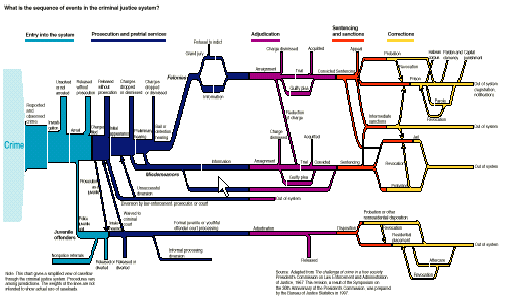
Criminal Justice Flowchart


"This flowchart of the events in the criminal justice system updates the original chart prepared by the President's Commission on Law Enforcement and the Administration of Justice in 1967. Accompanied by a clarifying text description, the chart summarizes the most common events in the criminal and juvenile justice systems including entry into the criminal justice system, prosecution and pretrial services, adjudication, sentencing and sanctions, and corrections.

Electronic files of both full color and black and white versions of the chart available for downloading [from the Bureau of Justice Statistics.]"

8/14/2006

When Squirrels Attack

"Several people attacked by a squirrel at Central Park said they had one word for the animal:

'Nuts.'"

Read more in thisLiveScience.com article

Risk is a Gift You Give Yourself

"'When in your life did you feel most alive?'...

I have asked hundreds of people the same question and have been struck by the similarity of their answers. In particular I've noticed 3 themes. (1) Nearly everyone describes a scenario in which they pushed themselves out of their comfort zone and took risks. (2) The OUTCOME of taking the risk is rarely the main thrust of the story - it's usually the process of taking them that they remember most fondly. (3) When people finish their story, they've often got a big smile on their face.

Consider This:

The gift of risk-taking doesn't lie in what you achieve by risking - it lies in who you become as a result of the process. Confident. Engaged. Alive..."

Read more in this Doug Sundheim post found via an Arnie Herz item.

Technorati Tags: , , , ,

Sounds of Silence

This struck me kinda funny, even though I recognize the value of quietude in meditation practice:

"These audio files consist of various lengths of silence..."

8/13/2006

Yiddish People

I am fascinated by the Yiddish language, particularly the way some words seem to actually embody what they describe. Consider the following list of Yiddish people. I am sure there are many more.

Baleboost - boss

Bulvan - cement head

Bubba-Myse - liar

Bubbe - grandmother

Bubeleh - (little grandmother) term of endearment

Gonif - thief, crook, swindler

Kaker - old fart

Kibbitzer - wise guy

Macher - a big wheel, the real deal, celebrity

Mamala - baby

Maven - expert

Mensch - a decent, upright, honorable person of good character

Meshuggeneh - crazy, obsessive person

Nebbish - a wimp, nerd, dork

Nudj - little pest

Nudnick - a pest and a bore

Putz - schmuck

Rabbi, Rebbe - teacher, spiritual leader

Shmuck - idiot

Shnook - unassertive patsy; gullible dummy

Shnorrer - a moocher, freeloader, cheapskate

Shmegegge - a no talent, someone who brings nothing to the party

Shlemiel - foolish person, hard-luck type, clumsy person

Shlimazl - unlucky person; born loser

Shlump - drip; party pooper

Shmo - jerk

Yenta - a meddlesome gossip

Zayde - grandfather

Technorati Tags: , , , ,

Life is More

I recently rediscovered notes I took from an article I read in 1997. These ideas still resonate with me and I thought I would share them. If you know the article where I originally found these words, please let me know so I may make proper attribution.

Life is more than a striving for money, power and position. There will never be enough money. Money does not bring satisfaction. Power is fleeting. Position is even less permanent.

Many lawyers are engaged in a frantic chase for the brass ring just out of reach, responding to the siren call of billable hours, revenues origination, selling their lives for money, one hour at a time.

The quality of a lawyer's life is an important element of law practice.

A complaint echoes throughout the land, "The practice of law is no longer a profession. It is a business."

The focus of our practice must be on service to our clients, with monetary reward a by-product of that service. We can not let money become the main goal with service the by-product.

Take responsibility for your present situation and your future. Do not blame others. Focus your efforts on those areas you can truly influence.

Double the time on the job you use your strengths and talents.

Develop a plan to solve a challenge or creating something of value that will be both beyond expectations and of major value to your organization. Clarify with the person to whom you report your mutual expectations of each other.

Double the time you spend listening to others.

Technorati Tags: , , , ,

8/09/2006

Dream the Possible Dream

"The secret to breaking out of the box is to dream. Don’t be afraid to dream. Don’t be ashamed. Don’t be held back by your own doubts. Don’t be held back by others’. Dream big and dream real. And then keep trying different methods to fulfill your dream."

So concludes this wonderful post by J. Timothy King citing the following passage from The Bear Necessities of Business: Building a Company with Heart by Maxine Clark, the founder of Build-A-Bear Workshop®:

People often ask how I was able to take the rough idea for Build-A-Bear Workshop and turn it into such a successful business. Above all, it started when I simply allowed myself to dream. And I’m a true believer in dreaming big.

Since the very beginning, I didn’t put restrictions on my vision, nor did I let the way others made or sold stuffed animals stand in my way. Instead, I allowed myself to dream of this unique business going from one store at the Saint Louis Galleria to something that could be as huge as I thought it could be. My dream eventually came true, and continues to evolve even beyond my wildest imagination. But you must start by believing you can truly achieve whatever you set your mind to, no matter how monumental it might seem.

Most people don’t do that. They stymie themselves and their ideas with negative thoughts. They’re so caught up in what they can’t do that they don’t think about how much they can accomplish. As Marianne Williamson wrote in Return to Love, “Our deepest fear is not that we are inadequate. Our deepest fear is that we are powerful beyond measure. It is our Light, not our Darkness, that most frightens us."

Technorati Tags: , , , ,

8/08/2006

Seven Habits Revisited

In this article from Motivation Articles, Essays, Tips and Advice, author Steven Covey revisits and reinvisions his Seven Habits of Highly Successful People, stating:

"I see seven unique human endowments or capabilities associated with The Seven Habits of Highly Effective People. One way to revisit The Seven Habits of Highly Effective People is to identify the unique human capability or endowment associated with each habit.

The primary human endowments are 1) self-awareness or self-knowledge; 2) imagination and conscience; and 3) volition or will power. And the secondary endowments are 4) an abundance mentality; 5) courage and consideration; and 6) creativity. The seventh endowment is self-renewal. These are all unique human endowments; animals don't possess any of them. But, they are all on a continuum of low to high levels.

Associated with Habit 1:
Be Proactive is the endowment of self-knowledge or self-awareness, an ability to choose your response (response-ability)...

Associated with Habit 2:
Begin With the End In Mind is the endowment of imagination and conscience...

Associated with Habit 3:
Put First Things First is the endowment of willpower...

Associated with Habit 4:
Think Win-Win is the endowment of an abundance mentality. Why? Because your security comes from principles...

Associated with Habit 5:
Seek First to Understand, Then to Be Understood is the endowment of courage balanced with consideration...

Associated with Habit 6:
Synergize is the endowment of creativity...

Associated with Habit 7:
Sharpen the Saw is the unique endowment of continuous improvement or self-renewal to overcome entropy..."

What Makes Angels Tick?

Brad Feld writes:

"David Cohen, a Boulder-based entrepreneur and angel investor who I’ve done a few angel investments with and am now working on an interesting project with, has a great post up on how angel investors make investment decisions. If you are raising angel money, it’s worth a read."

Please see Brad's post for a link to Mr. Cohen's piece.

Technorati Tags: , , , ,

Looking for Happiness in All the Wrong Places

"Psychologists have conducted a number of research studies trying to analyze what makes people happy, and the results are startling. Most of the time, it turns out that we're looking in the wrong places.

Money, for instance, is only important until you have enough to meet your basic needs. After that, it has little effect on long-term, deep down happiness...

What elements are thought to bring happiness, and how can you integrate more of them into your life?

Cultivate Intimate Friendships...

Says [Dr. Dean] Ornish...'Spending time with the people we care about isn't what we do after the important stuff is done. It is the important stuff.'

To build more intimacy into your life, Ornish suggests that you:

* Help others.
* Communicate how you feel. Say "I feel angry..." rather than "I am angry with you..."
* Listen to others and show you've heard them.
* Get a dog...
* Find spirituality...

Go With the Flow

People are often happiest when in a state called 'flow'...the state that occurs when your body and mind are totally absorbed in a task that challenges you without overwhelming you...

Get Married...

But a ring on the finger isn't enough in and of itself. It's the quality of the relationship that counts...there are four important similarities among relationships in which the people are satisfied:

* The ability to talk openly.
* Respect. "Don't try to bend the other person to see things through your eyes," says Cole.
* A sense of humor.
* The ability to work as a team, utilizing each other's strengths and pulling in the same direction...

Increase your happiness wherever you work:

* Don't just sit back and wait for opportunities to happen, be proactive in finding out what is available.
* Build up a good morale and camaraderie among the people you work with.
* Make sure you have a good "fit" between what motivates you and what you do each day..."

Read more in this interesting article from Beliefnet.com

8/07/2006

Protecting Intellectual Property

"Intellectual property (IP) protection is a fundamental part of our nation's founding. The U.S. Constitution, establishing the only 'right' in its text, states that 'To promote the Progress of Science and useful Arts, by securing for limited Times to Authors and Inventors the exclusive Right to their Respective Writings and Discoveries.' Even Abraham Lincoln stated our patent system adds 'the fuel of interest to the fire of genius.' This Collection [from Kauffman eVenturing] covers the range of issues around how entrepreneurs can protect their company's IP. Upcoming Collections will cover related emerging issues surrounding IP protection, including open source IP and its impact on entrepreneurship."

Technorati Tags: , , , ,

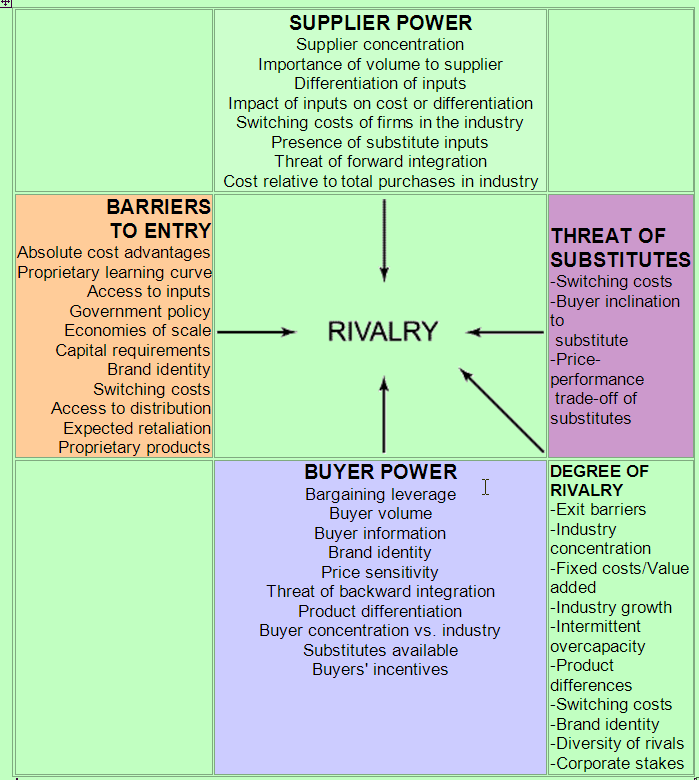
Five Forces Drive Profitability

"Numerous economic studies have affirmed that different industries can sustain different levels of profitability; part of this difference is explained by industry structure.

Michael Porter provided a framework that models an industry as being influenced by five forces. The strategic business manager seeking to develop an edge over rival firms can use this model to better understand the industry context in which the firm operates.

Diagram of Porter's 5 Forces


Refer to this QuickMBA article for a detailed explanation of the foregoing diagram and Porter's Five Forces.

Technorati Tags: , , , ,

8/06/2006

Guide to Getting Growth Capital

"There is no shortage of funds available to small and medium-sized growth-oriented firms. So why do so many entrepreneurs have difficulty finding the money they need to help their businesses grow? The problem seems to be that many small and medium-sized businesses don't know how to go about raising money from different types of lenders. If you don't have a clear strategy for raising capital, you probably won't find any.

This Steps to Growth Capital Self-Study Guide [from Industry Canada] is designed to help you develop the plan, the materials and the confidence to go after the equity financing you need to launch your business opportunity and achieve your business goals. This guide has been prepared for potential or established owner-managed companies that want to learn about equity investment as a means to funding growth.

Most small companies are simply not "investor-ready" — investors feel these entrepreneurs don't have what it takes to even be considered for financing. They haven't analysed their financial needs, haven't demonstrated their investment potential or management capabilities, or haven't produced an effective investment proposal. Why?

* Some of the problems that entrepreneurs face stem from a misunderstanding of what risk capital is and how it differs from traditional financing.

* Entrepreneurs may not have one of the kinds of businesses that interest investors.

* Many entrepreneurs who are good candidates for risk capital still need to go through the steps required to become "investor-ready" to understand the needs of investors and demonstrate that they have real growth potential.

The Steps to Growth Capital guide will help you learn about risk capital and will prepare you and your firm to go after it..."

Technorati Tags: , , , ,

8/03/2006

SCORE Revamps Web Site

SCORE "Counselors to America's Small Business" announces a fresh, new look for the SCORE Small Business Web Site, www.score.org, designed to be more visually appealing and easier for clients and visitors to use. New How-To and Business Tools sections offer valuable guides, templates and resources to help small business owners achieve success.

Through focus groups with SCORE small business owners, SCORE found that entrepreneurs wanted more information on starting, financing, managing and growing a business. SCORE re-organized online content around each of those themes. How-To articles provide tips and advice on a variety of topics, including business plans, venture capital, customer relations and increasing sales. Business Tools links offer access to SCORE online workshops, template gallery, business quizzes, public relations toolkit and other free resources.

As part of the Web site makeover, SCORE refined navigation features and added a site map to make getting around easier. A new Ask SCORE box on the home page gives quick access to SCORE’s free and confidential online counseling. Each page now includes a ZIP code finder to find a local SCORE office. New photos added to each page support SCORE’s awareness campaign theme, Live Your Dream. SCORE Can Help.

From a press release found via this National Business Association site

Technorati Tags: , , , ,

7/27/2006

Friends, Family, Fools, Banks, VCs, Angels & Everything: How to Finance a Startup

This is a great collection of articles on how to finance your startup from entrepreneur.com. A quick glance at the article titles gives an idea of the depth and breadth of the topics covered:

How to Attract VC Investors
Capital Gains
Little-Known Funding Faux Pas
Guide and Seek
What Bankers Look For in a Plan
What Investors Look For in a Plan
Making Bank
Do You Need Excellent Credit to Start a Business?
The Other Colors of Money
Dipping Into Your Retirement Fund to Start a Business
Getting Funding for Your Growing Business
Dividing Equity Between Founders and Investors
Truth & Consequences
The Search Is On
Starting a Business in an Urban Market
Out on a Limb
Plastic Rap
Bootstrapping Your Startup
How to Set Starting Salaries
Personal Loan Guarantees
A Penny Saved
Using Home Equity to Get a Business Loan
Granting Your Wishes
Been There, Done That
Can Startups Get Venture Capital?
Under the Microscope
Can I Take Your Orders?
Using Personal Assets for Funding
Startup Financing
Develop Your Idea With Pre-Launch Funding
Minority Loan and Grant Programs
Playing an Angel
Springing Back
Microloans Could Fuel Macro Results
Keep Your Banker Informed
The Anatomy of a Financing Deal
Bringing In a Partner
Loans Fuel Growth for Small Companies
Write Soon
How Cutting Costs Can Save Your Business
Understanding the Financing Stages
Learn by Pitching
Using Credit Cards to Finance Your Startup
Going Once, Going Twice Sold!
No Money? No Problem
Keep It Real
Give A Little, Get A Little
What Women Want
Enticing Investors
Got Cash?
On The Money
Read The Fine Print
Gaining Interest
Money for Ownership?
A League Of Their Own
Determining Returns On Investments
Building Business Relationships
Look 'Em in the Eyes
Get Rid of Debt
A Question Of Character
"C" Your Way Through It
Need Money? Look Here.
Your Butt on the Line
Money-Saving Tips
First Line Of Financing
What About Me?
Secret To My Financing
Where the Funds Are
21 Quick Start-Up Fixes

Technorati Tags: , , , ,

7/26/2006

Find What You Love to Do

Brian Kim refers to Steve Jobs’ commencement speech at Stanford University, stating:

"In it, he says the advice we’ve all heard a thousand times:

'You’ve got to find what you love. And that is as true for your work as it is for your lovers. Your work is going to fill a large part of your life, and the only way to be truly satisfied is to do what you believe is great work. And the only way to do great work is to love what you do.” '- Steve Jobs

Well then, the question naturally arises, how do you find what you love to do? It’s such a big question.

What absolutely boils my blood is that we hear we should be doing what we love to do all the time, but there’s not any step by step advice out there on how to find what you love to do."

Problem solved - as Brian lays it out step by step - in How to Find What You Love to Do, observing, as to why people don't just quit the jobs they hate and do what they love:

"Two Reasons.

Reason #1: They don’t know what they love to do.

Reason #2: Fear...

Conquer indecision in Reason #1 and act, and you will most definitely conquer all fear in Reason #2...

It is extremely important to answer the question on how to find what you love to do.

You must decide what destination to steer your life in. Otherwise, you leave yourself wide open for others to direct your life, as well as at the mercy of the winds and storms of life. If you know where your destination is, the rest is easy.

You will find once you know what you want to do, all uncertainty and burden will be lifted off your shoulders and you will have clear vision as to what your journey is and that journey will truly be joyful."

Forecasting by the Waterfall

"One of the toughest jobs of a startup CEO is putting together an accurate revenue forecast...

One of the forecasting tools I recommend...is a Waterfall Forecast. Typically, this is an Excel spreadsheet that allows a company to show how the forecast for a given month (or quarter) has changed over time.

Over time, a waterfall forecast creates an environment of accountability and allows a CEO (and Board of Directors) to determine key trends..."

Read more, including an Excel spreadsheet presenting an example waterfall forecast in this Redeye VC post.

Technorati Tags: , , , ,

U.S. Export Controls Labyrinth

Most businesses are surprised that United States takes the position that

"Export Controls apply to all U.S. origin products. Although some controls are more strict than others, exporters are required by law to report all exports to U.S. Customs. In addition, exports from specific product categories must be reported to the agency or agencies that govern that type of export. If your company exports products specifically designed for military applications, they must report to U.S. Customs and the Department of State.

In addition, export controls apply to all U.S. origin technical data. Similar to the controls governing U.S. origin products, all technical data produced in the United States is subject to export controls. If your company exports technical data that is directly related to military hardware and applications they must report to U.S. Customs and the Department of State.

Export controls for your company may also apply to foreign components that result from U.S. data, services supplied by U.S. persons, and the employment of foreign nationals...

The U.S. Department of Commerce and the U.S. Department of State may have classified some your company's products as strategic. This means that some of your company's products have been specifically designed for, or inherently have possible military applications. According to U.S. export control regulations, your company must obtain permission from the U.S. Government to export these products or technologies to other countries. To prevent unauthorized export, it is crucial that all employees and management be aware of these regulations and maintain a program of strict compliance."

For more information, including a useful rss feed, see US State Department ITAR Export Compliance

Technorati Tags: , , , ,

7/25/2006

Software License Compliance Requires Vigilance

"Software compliance is often not a priority in an enterprise until there is a perceived risk of an audit. To determine if an enterprise has the staff and processes in place to maintain accurate license compliance, consider these questions:

* How long has it been since a meeting was held on contract compliance and asset management?
* Does the CIO know who is responsible for IT asset management?
* Are personnel trained in software license negotiation managing the technology contracts?
* Is there centralized technology procurement within the enterprise?
* How long has it been since a desktop audit was performed?
* Are asset management projects funded?
* Does the enterprise have written procedures on software procurement processes?
* Does the enterprise have written policies on software licenses that are not legally procured?

If the answer to any of these questions is 'no,' the enterprise has a high risk of noncompliance."

Read more in this collection of articles from gartner.com.

Technorati Tags: , , , ,

7/20/2006

Mistakes Entrepreneurs Should Avoid

"This is a list of what I consider are the top 14 stumbling blocks for new businesses...

1. Bad initial concept...
2. Inadequate planning...
3. Failure to do proper research...
4. Insufficient capital...
5. Poor cash management...
6. Lack of business domain specific knowledge...
7. Chasing any potential sale...
8. Late billing and collections...
9. Lack of focus...
10. Lack of internal control systems...
11. Hiring the wrong people...
12. Reliance on few suppliers or customers...
13. Not having enough perseverance and resilience...
14. Insufficient performance metrics..."

Read more in this post from Dave Cheong.

Technorati Tags: , , , ,

7/19/2006

E&Y Business Plan Guide

The Guide to Producting a Business Plan available at this Ernst & Young website focuses on the necessary steps to produce a business plan for the purposes of raising finance, giving guidance on what to include in, and how to present, the plan. "It also incorporates tips which are derived from Ernst & Young’s substantial experience in assisting a wide range of clients to produce business plans for many different reasons."

Technorati Tags: , , , ,

Ten Steps to Build an Innovative Organization

Paul Sloane, a leading authority on innovation, outlines ten steps to create an innovative organization. The ten steps are:

"(1) Paint an inspiring vision.

(2) Build an open, receptive, questioning culture.

(3) Empower people at all levels.

(4) Set goals, deadlines and measurements for innovation.

(5) Use creativity techniques to generate a large number of ideas.

(6) Look outside for ideas

(7) Review, combine, filter and select ideas.

(8) Prototype promising proposals.

(9) Manage risk and accept failure.

(10) Kill off the unpromising projects and quickly roll out the successful ones."

Found via this post from Business Innovation Insider

Technorati Tags: , , , ,

Delphi Brainstorming Technique

"The purpose of the Delphi technique is to elicit information and judgments from participants to facilitate problem-solving, planning, and decision-making. It does so without physically assembling the contributors. Instead, information is exchanged via mail, FAX, or email. This technique is designed to take advantage of participants’ creativity as well as the facilitating effects of group involvement and interaction. It is structured to capitalize on the merits of group problem-solving and minimize the liabilities of group problem-solving."

Read more in this post from Professor Randall B. Dunham that explains the technique and provides forms.

Technorati Tags: , , , ,

7/17/2006

Venture Capitalists Pledge $10 Million to Save the Tiger

"Conservation-minded venture capitalists have pledged $10 million to support a scientific effort aimed at saving tigers. In a twist for science, specific results have been promised in what researchers are calling a business plan for the big cats.

The effort, started yesterday and led by the Wildlife Conservation Society (WCS), is called Tigers Forever. The scientists say proper conservation could increase tiger numbers across a dozen sites from 800 to 1,200. The program's predictions are based on successes in bolstering tiger populations in India's Nagarahole National Park and the Russian Far East.

Experts do not know how many tigers remain in the wild, but they believe there are only 3,000 to 5,000 left..."

Read more in this article from LiveScience.com

7/13/2006

Shareholder Agreement Basics

"When a company is formed, its shareholders may decide on a set of ground rules over and above the basic legislation that will govern their behavior. For example, how do you handle a shareholder who wants 'out' (and sell her shares)? Should it be possible to "force" (i.e. buyout) a shareholder? How are disagreements handled? Who gets to sit on the Board? What authority is given to whom for various decision-making activities? And so on...

A company which is wholly owned by one person need not have such an agreement. However, as soon as there are more than one owners, such an agreement is essential. The spirit of such an agreement will depend on what type of company is contemplated. For example, a three-owner retail shop may adopt a totally different approach to that of a high tech venture which may have many owners. When a company has hundreds of shareholders or becomes a 'public' company, the need for such an agreement disappears and the applicable act and securities regulations then take over."

Read more, including a good list of questions to answer in completing a stockholders agreement, in this article from Mike Volker

Technorati Tags: , , , ,

7/12/2006

2006 Major League Baseball All Star Week Report


Since Friday for me it has been Baseball, Baseball and more Baseball.

I volunteered at All-Star FanFest on Friday and Saturday. Attended the FanFest each day Friday through Tuesday. Scalped tickets to the highly enjoyable Futures and Legends/Celebrities Softball Games Sunday.


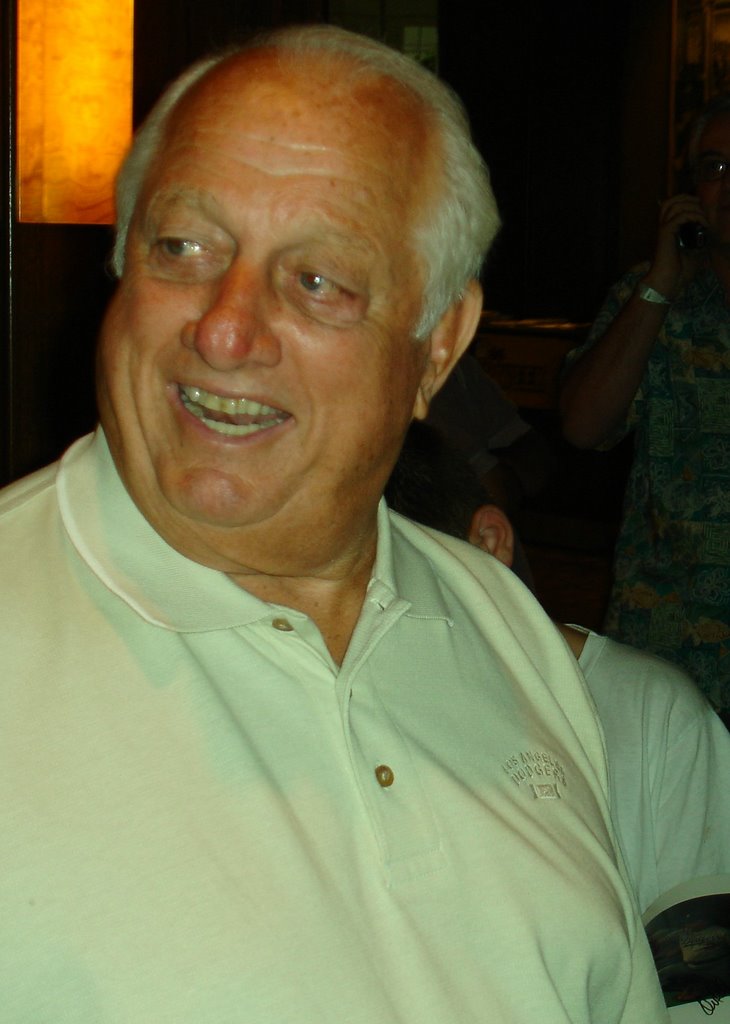
On Monday, I hung out for an hour at the Westin and said hello to Tommy Lasorda, Ozzie Smith, Dave Parker, Alex Rodriguez, and Ernie Banks.


The tying home run Ryan Howard hit in the finals of the Home Run Derby landed within a few feet of where I was standing behind the aisle near the ESPN broadcast booth in right centerfield. A bunch of crazies dove over the low barriers surrounding the ESPN setup, scrambling under the scaffolding supporting broadcasters John Kruk et.al., frantically searching, wriggling and fighting each other for the ball that had disappeared under the curtains hiding the structure.

I had a great view of Howard's thrilling winning homerun smacking the "Hit It Here" sign. Afterward, I volunteered at a FanFest invitation only gala, arriving home late, only to stay awake watching the Home Run Derby highlights on ESPN.

On Tuesday, I attended the memorabilia auction at FanFest where Bill Mazeroski opened the festivities with a surprise appearance to auction off his only game-used baseball glove for proceeds to benefit his scholarship fund. A bidder paid $16,000 for the well worn treasure and Maz graciously autographed it for him.

The featured item of the auction - the ball autographed by Babe Ruth that he hit for the first ever All-Star game homerun - brought over $800,000. Click Here and scroll down to "All Star History" to watch a video of the Babe hitting the historic home run. The bat Ruth used to hit his 59th homerun in 1921 was acquired for $460,000.

The city of Pittsburgh welcomed the players by turning the Roberto Clemente bridge into the world's largest red carpet where the arriving stars and their families rode in open air vehicles as the delighted fans cheered them from the edges of the route across the bridge to PNC Park.

The All-Star game itself was fun and exciting featuring a great atmosphere and a low scoring game with a thrilling ending that dissappointed the majority of fans who were pulling for the Nationals and had been standing, cheering for the last out to seal the victory that was not to be.


All in All - Awesome!

7/10/2006

Know the Rules and Plan Accordingly

"There are some fundamental rules successful investors, be they angels or VC’s, have in their bible...

Rule No 1 - The idea is worth only 20% of the value of the venture...

Rule No 2 - People – not ideas technology or money - build companies, thus they are worth 50% of the value of the venture...

Rule No 3 - Structure is worth 30% of the value of the venture. Investing millions in a brilliant idea executed by a skilled, passionate and connected entrepreneur without a structured and validated market, sales, operation, product development, financial plan and team to execute it will burn through any investment in a very short period without creating revenue.

Rule No 4 - Only products and services that can relieve a significant identified group of customer’s pains can generate revenue...

Rule No 5 - Investors expect to exit with significant returns within six years...

Read more in this essay by Gerry Lemberg that he uses as a supplement to a seminar called “Planning, Funding, Executing, and Exiting a New Venture” which he gives regularly.

Technorati Tags: , , , ,

Retirement Plans for Small Businesses

"Here are some highlights of four retirement plans that work well for small businesses.

SEP-IRA
The Simplified Employee Pension, commonly referred to as a SEP or SEP-IRA, is widely used because it is easy to establish and maintain.

An employer contributes to a traditional individual retirement account set up by or for each eligible employee. The employee owns and controls the IRA, but does not put any money into the account...

SIMPLE IRA
One of the easier plans to establish and maintain, a SIMPLE IRA is an acronym for Savings Incentive Match Plan for Employees and includes contributions made directly to each eligible employee's IRA...Employees can contribute to the plan. As employer, you can match employee contributions (up to 3 percent) or to make non-elective contributions (up to 2 percent) to employee accounts, regardless of whether workers contribute.

401(k)
...A 401(k) program is a good benefit for companies with a mix of rank-and-file employees and owners/managers. It also offers participants a wider range of investment options. New in 2006, you can set up the plan so that workers can designate some or all of their contributions as after-tax Roth investments, making eventual distribution of such money tax-free.

Both company and employee contributions are allowed. As employer, you can contribute on behalf of all participants, match a portion of your employees' contributions or do both.

Of course, the greater benefits and options of a 401(k) plan mean more work for employers: creating a written plan, setting up a trust fund for plan assets, record keeping, keeping workers informed. Because of these and other administrative requirements, companies usually contract with an outside firm to handle some or all of the of a 401(k) plan's operational aspects.

Companies with 100 or fewer employees have the option of establishing a SIMPLE 401(k), which follows many of SIMPLE IRA guidelines. Individual 401(k) plans, sometimes called Solo(k)s, also are available to sole proprietors.

Profit sharing
As the name indicates, this plan allows you to share your company's success with your workers.

You don't need to provide a definite formula for figuring out the profits to be shared. Your annual company contribution also is discretionary. However, you must make systematic and substantial contributions to the plan.

You also must provide a precise calculation for allocating the contribution amount to the plan's participants, as well as for distributing it when employees meet plan guidelines...

Read more in this article from nfib.com.

Technorati Tags: , , , ,

7/06/2006

Open Source Q&A

"4. What are the different types of open source licenses?

At one extreme, some open source projects allow their code to be copied and distributed as part of other applications without any significant restrictions. At the other extreme, some licenses require that source code for derivative works be distributed, and that those derivative works be licensed under the same terms as the original open source code. In some circumstances, if a company includes and distributes such open source software in its proprietary software, the company might be required to distribute source code for at least some of its proprietary software under an open source license. And there are dozens of other license variations in between these two extremes. Just as when companies license commercial software, companies should understand the terms under which open source software is offered...

7. How does open source software affect my intellectual property?

Because software is protected by various intellectual property regimes (e.g., patents, copyrights and trade secrets), use of open source can affect a company’s IP rights in many ways. Companies that distribute proprietary software products should consider whether use of open source in their products would result in a potential loss of copyright or trade secret protection. Some open source licenses also may be interpreted as licenses to any of the company’s patents that cover the distributed code. Some licenses also include a "patent termination" clause that revokes any license to the open source software should a company assert patents against any current licensee of the open source software...

10. How can I safely implement open source into my development process?

As with any new technology or practice, companies can develop procedures that facilitate the identification, review, approval and ongoing compliance with the various license terms and internal guidelines. Typically, this involves scheduling management and developer time to review open source usage before it makes its way into a final product, maintaining a list of approved open source software and the associated licenses, and performing periodic or ongoing audits, possibly using new "code auditing" tools that are available."

Read the other seven questions and answers in this Goodwin Procter article from Mondaq.

Technorati Tags: , , , ,