8/08/2006

Seven Habits Revisited

In this article from Motivation Articles, Essays, Tips and Advice, author Steven Covey revisits and reinvisions his Seven Habits of Highly Successful People, stating:

"I see seven unique human endowments or capabilities associated with The Seven Habits of Highly Effective People. One way to revisit The Seven Habits of Highly Effective People is to identify the unique human capability or endowment associated with each habit.

The primary human endowments are 1) self-awareness or self-knowledge; 2) imagination and conscience; and 3) volition or will power. And the secondary endowments are 4) an abundance mentality; 5) courage and consideration; and 6) creativity. The seventh endowment is self-renewal. These are all unique human endowments; animals don't possess any of them. But, they are all on a continuum of low to high levels.

Associated with Habit 1:
Be Proactive is the endowment of self-knowledge or self-awareness, an ability to choose your response (response-ability)...

Associated with Habit 2:
Begin With the End In Mind is the endowment of imagination and conscience...

Associated with Habit 3:
Put First Things First is the endowment of willpower...

Associated with Habit 4:
Think Win-Win is the endowment of an abundance mentality. Why? Because your security comes from principles...

Associated with Habit 5:
Seek First to Understand, Then to Be Understood is the endowment of courage balanced with consideration...

Associated with Habit 6:
Synergize is the endowment of creativity...

Associated with Habit 7:
Sharpen the Saw is the unique endowment of continuous improvement or self-renewal to overcome entropy..."

What Makes Angels Tick?

Brad Feld writes:

"David Cohen, a Boulder-based entrepreneur and angel investor who I’ve done a few angel investments with and am now working on an interesting project with, has a great post up on how angel investors make investment decisions. If you are raising angel money, it’s worth a read."

Please see Brad's post for a link to Mr. Cohen's piece.

Technorati Tags: , , , ,

Looking for Happiness in All the Wrong Places

"Psychologists have conducted a number of research studies trying to analyze what makes people happy, and the results are startling. Most of the time, it turns out that we're looking in the wrong places.

Money, for instance, is only important until you have enough to meet your basic needs. After that, it has little effect on long-term, deep down happiness...

What elements are thought to bring happiness, and how can you integrate more of them into your life?

Cultivate Intimate Friendships...

Says [Dr. Dean] Ornish...'Spending time with the people we care about isn't what we do after the important stuff is done. It is the important stuff.'

To build more intimacy into your life, Ornish suggests that you:

* Help others.
* Communicate how you feel. Say "I feel angry..." rather than "I am angry with you..."
* Listen to others and show you've heard them.
* Get a dog...
* Find spirituality...

Go With the Flow

People are often happiest when in a state called 'flow'...the state that occurs when your body and mind are totally absorbed in a task that challenges you without overwhelming you...

Get Married...

But a ring on the finger isn't enough in and of itself. It's the quality of the relationship that counts...there are four important similarities among relationships in which the people are satisfied:

* The ability to talk openly.
* Respect. "Don't try to bend the other person to see things through your eyes," says Cole.
* A sense of humor.
* The ability to work as a team, utilizing each other's strengths and pulling in the same direction...

Increase your happiness wherever you work:

* Don't just sit back and wait for opportunities to happen, be proactive in finding out what is available.
* Build up a good morale and camaraderie among the people you work with.
* Make sure you have a good "fit" between what motivates you and what you do each day..."

Read more in this interesting article from Beliefnet.com

8/07/2006

Protecting Intellectual Property

"Intellectual property (IP) protection is a fundamental part of our nation's founding. The U.S. Constitution, establishing the only 'right' in its text, states that 'To promote the Progress of Science and useful Arts, by securing for limited Times to Authors and Inventors the exclusive Right to their Respective Writings and Discoveries.' Even Abraham Lincoln stated our patent system adds 'the fuel of interest to the fire of genius.' This Collection [from Kauffman eVenturing] covers the range of issues around how entrepreneurs can protect their company's IP. Upcoming Collections will cover related emerging issues surrounding IP protection, including open source IP and its impact on entrepreneurship."

Technorati Tags: , , , ,

Five Forces Drive Profitability

"Numerous economic studies have affirmed that different industries can sustain different levels of profitability; part of this difference is explained by industry structure.

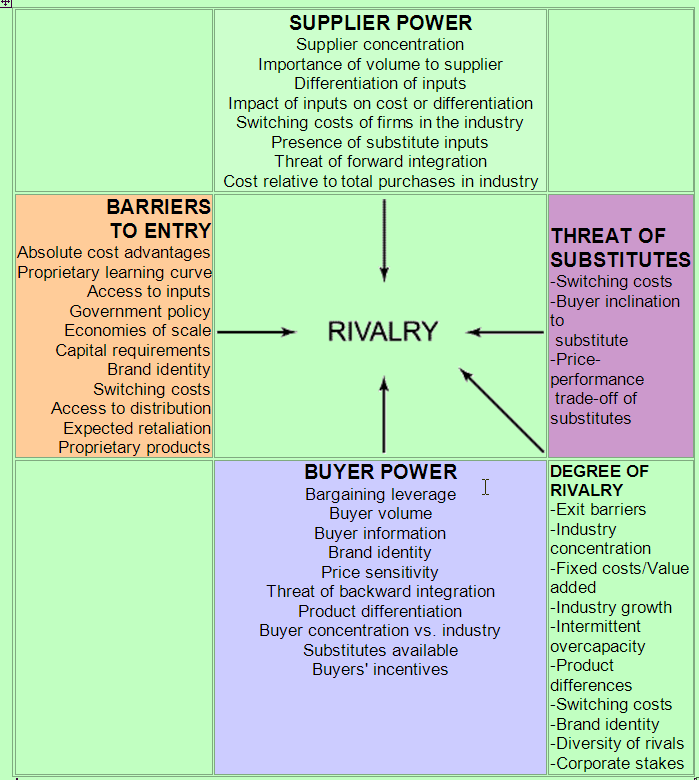
Michael Porter provided a framework that models an industry as being influenced by five forces. The strategic business manager seeking to develop an edge over rival firms can use this model to better understand the industry context in which the firm operates.

Diagram of Porter's 5 Forces


Refer to this QuickMBA article for a detailed explanation of the foregoing diagram and Porter's Five Forces.

Technorati Tags: , , , ,

8/06/2006

Guide to Getting Growth Capital

"There is no shortage of funds available to small and medium-sized growth-oriented firms. So why do so many entrepreneurs have difficulty finding the money they need to help their businesses grow? The problem seems to be that many small and medium-sized businesses don't know how to go about raising money from different types of lenders. If you don't have a clear strategy for raising capital, you probably won't find any.

This Steps to Growth Capital Self-Study Guide [from Industry Canada] is designed to help you develop the plan, the materials and the confidence to go after the equity financing you need to launch your business opportunity and achieve your business goals. This guide has been prepared for potential or established owner-managed companies that want to learn about equity investment as a means to funding growth.

Most small companies are simply not "investor-ready" — investors feel these entrepreneurs don't have what it takes to even be considered for financing. They haven't analysed their financial needs, haven't demonstrated their investment potential or management capabilities, or haven't produced an effective investment proposal. Why?

* Some of the problems that entrepreneurs face stem from a misunderstanding of what risk capital is and how it differs from traditional financing.

* Entrepreneurs may not have one of the kinds of businesses that interest investors.

* Many entrepreneurs who are good candidates for risk capital still need to go through the steps required to become "investor-ready" to understand the needs of investors and demonstrate that they have real growth potential.

The Steps to Growth Capital guide will help you learn about risk capital and will prepare you and your firm to go after it..."

Technorati Tags: , , , ,

8/03/2006

SCORE Revamps Web Site

SCORE "Counselors to America's Small Business" announces a fresh, new look for the SCORE Small Business Web Site, www.score.org, designed to be more visually appealing and easier for clients and visitors to use. New How-To and Business Tools sections offer valuable guides, templates and resources to help small business owners achieve success.

Through focus groups with SCORE small business owners, SCORE found that entrepreneurs wanted more information on starting, financing, managing and growing a business. SCORE re-organized online content around each of those themes. How-To articles provide tips and advice on a variety of topics, including business plans, venture capital, customer relations and increasing sales. Business Tools links offer access to SCORE online workshops, template gallery, business quizzes, public relations toolkit and other free resources.

As part of the Web site makeover, SCORE refined navigation features and added a site map to make getting around easier. A new Ask SCORE box on the home page gives quick access to SCORE’s free and confidential online counseling. Each page now includes a ZIP code finder to find a local SCORE office. New photos added to each page support SCORE’s awareness campaign theme, Live Your Dream. SCORE Can Help.

From a press release found via this National Business Association site

Technorati Tags: , , , ,

7/27/2006

Friends, Family, Fools, Banks, VCs, Angels & Everything: How to Finance a Startup

This is a great collection of articles on how to finance your startup from entrepreneur.com. A quick glance at the article titles gives an idea of the depth and breadth of the topics covered:

How to Attract VC Investors
Capital Gains
Little-Known Funding Faux Pas
Guide and Seek
What Bankers Look For in a Plan
What Investors Look For in a Plan
Making Bank
Do You Need Excellent Credit to Start a Business?
The Other Colors of Money
Dipping Into Your Retirement Fund to Start a Business
Getting Funding for Your Growing Business
Dividing Equity Between Founders and Investors
Truth & Consequences
The Search Is On
Starting a Business in an Urban Market
Out on a Limb
Plastic Rap
Bootstrapping Your Startup
How to Set Starting Salaries
Personal Loan Guarantees
A Penny Saved
Using Home Equity to Get a Business Loan
Granting Your Wishes
Been There, Done That
Can Startups Get Venture Capital?
Under the Microscope
Can I Take Your Orders?
Using Personal Assets for Funding
Startup Financing
Develop Your Idea With Pre-Launch Funding
Minority Loan and Grant Programs
Playing an Angel
Springing Back
Microloans Could Fuel Macro Results
Keep Your Banker Informed
The Anatomy of a Financing Deal
Bringing In a Partner
Loans Fuel Growth for Small Companies
Write Soon
How Cutting Costs Can Save Your Business
Understanding the Financing Stages
Learn by Pitching
Using Credit Cards to Finance Your Startup
Going Once, Going Twice Sold!
No Money? No Problem
Keep It Real
Give A Little, Get A Little
What Women Want
Enticing Investors
Got Cash?
On The Money
Read The Fine Print
Gaining Interest
Money for Ownership?
A League Of Their Own
Determining Returns On Investments
Building Business Relationships
Look 'Em in the Eyes
Get Rid of Debt
A Question Of Character
"C" Your Way Through It
Need Money? Look Here.
Your Butt on the Line
Money-Saving Tips
First Line Of Financing
What About Me?
Secret To My Financing
Where the Funds Are
21 Quick Start-Up Fixes

Technorati Tags: , , , ,

7/26/2006

Find What You Love to Do

Brian Kim refers to Steve Jobs’ commencement speech at Stanford University, stating:

"In it, he says the advice we’ve all heard a thousand times:

'You’ve got to find what you love. And that is as true for your work as it is for your lovers. Your work is going to fill a large part of your life, and the only way to be truly satisfied is to do what you believe is great work. And the only way to do great work is to love what you do.” '- Steve Jobs

Well then, the question naturally arises, how do you find what you love to do? It’s such a big question.

What absolutely boils my blood is that we hear we should be doing what we love to do all the time, but there’s not any step by step advice out there on how to find what you love to do."

Problem solved - as Brian lays it out step by step - in How to Find What You Love to Do, observing, as to why people don't just quit the jobs they hate and do what they love:

"Two Reasons.

Reason #1: They don’t know what they love to do.

Reason #2: Fear...

Conquer indecision in Reason #1 and act, and you will most definitely conquer all fear in Reason #2...

It is extremely important to answer the question on how to find what you love to do.

You must decide what destination to steer your life in. Otherwise, you leave yourself wide open for others to direct your life, as well as at the mercy of the winds and storms of life. If you know where your destination is, the rest is easy.

You will find once you know what you want to do, all uncertainty and burden will be lifted off your shoulders and you will have clear vision as to what your journey is and that journey will truly be joyful."

Forecasting by the Waterfall

"One of the toughest jobs of a startup CEO is putting together an accurate revenue forecast...

One of the forecasting tools I recommend...is a Waterfall Forecast. Typically, this is an Excel spreadsheet that allows a company to show how the forecast for a given month (or quarter) has changed over time.

Over time, a waterfall forecast creates an environment of accountability and allows a CEO (and Board of Directors) to determine key trends..."

Read more, including an Excel spreadsheet presenting an example waterfall forecast in this Redeye VC post.

Technorati Tags: , , , ,

U.S. Export Controls Labyrinth

Most businesses are surprised that United States takes the position that

"Export Controls apply to all U.S. origin products. Although some controls are more strict than others, exporters are required by law to report all exports to U.S. Customs. In addition, exports from specific product categories must be reported to the agency or agencies that govern that type of export. If your company exports products specifically designed for military applications, they must report to U.S. Customs and the Department of State.

In addition, export controls apply to all U.S. origin technical data. Similar to the controls governing U.S. origin products, all technical data produced in the United States is subject to export controls. If your company exports technical data that is directly related to military hardware and applications they must report to U.S. Customs and the Department of State.

Export controls for your company may also apply to foreign components that result from U.S. data, services supplied by U.S. persons, and the employment of foreign nationals...

The U.S. Department of Commerce and the U.S. Department of State may have classified some your company's products as strategic. This means that some of your company's products have been specifically designed for, or inherently have possible military applications. According to U.S. export control regulations, your company must obtain permission from the U.S. Government to export these products or technologies to other countries. To prevent unauthorized export, it is crucial that all employees and management be aware of these regulations and maintain a program of strict compliance."

For more information, including a useful rss feed, see US State Department ITAR Export Compliance

Technorati Tags: , , , ,

7/25/2006

Software License Compliance Requires Vigilance

"Software compliance is often not a priority in an enterprise until there is a perceived risk of an audit. To determine if an enterprise has the staff and processes in place to maintain accurate license compliance, consider these questions:

* How long has it been since a meeting was held on contract compliance and asset management?
* Does the CIO know who is responsible for IT asset management?
* Are personnel trained in software license negotiation managing the technology contracts?
* Is there centralized technology procurement within the enterprise?
* How long has it been since a desktop audit was performed?
* Are asset management projects funded?
* Does the enterprise have written procedures on software procurement processes?
* Does the enterprise have written policies on software licenses that are not legally procured?

If the answer to any of these questions is 'no,' the enterprise has a high risk of noncompliance."

Read more in this collection of articles from gartner.com.

Technorati Tags: , , , ,

7/20/2006

Mistakes Entrepreneurs Should Avoid

"This is a list of what I consider are the top 14 stumbling blocks for new businesses...

1. Bad initial concept...
2. Inadequate planning...
3. Failure to do proper research...
4. Insufficient capital...
5. Poor cash management...
6. Lack of business domain specific knowledge...
7. Chasing any potential sale...
8. Late billing and collections...
9. Lack of focus...
10. Lack of internal control systems...
11. Hiring the wrong people...
12. Reliance on few suppliers or customers...
13. Not having enough perseverance and resilience...
14. Insufficient performance metrics..."

Read more in this post from Dave Cheong.

Technorati Tags: , , , ,

7/19/2006

E&Y Business Plan Guide

The Guide to Producting a Business Plan available at this Ernst & Young website focuses on the necessary steps to produce a business plan for the purposes of raising finance, giving guidance on what to include in, and how to present, the plan. "It also incorporates tips which are derived from Ernst & Young’s substantial experience in assisting a wide range of clients to produce business plans for many different reasons."

Technorati Tags: , , , ,

Ten Steps to Build an Innovative Organization

Paul Sloane, a leading authority on innovation, outlines ten steps to create an innovative organization. The ten steps are:

"(1) Paint an inspiring vision.

(2) Build an open, receptive, questioning culture.

(3) Empower people at all levels.

(4) Set goals, deadlines and measurements for innovation.

(5) Use creativity techniques to generate a large number of ideas.

(6) Look outside for ideas

(7) Review, combine, filter and select ideas.

(8) Prototype promising proposals.

(9) Manage risk and accept failure.

(10) Kill off the unpromising projects and quickly roll out the successful ones."

Found via this post from Business Innovation Insider

Technorati Tags: , , , ,

Delphi Brainstorming Technique

"The purpose of the Delphi technique is to elicit information and judgments from participants to facilitate problem-solving, planning, and decision-making. It does so without physically assembling the contributors. Instead, information is exchanged via mail, FAX, or email. This technique is designed to take advantage of participants’ creativity as well as the facilitating effects of group involvement and interaction. It is structured to capitalize on the merits of group problem-solving and minimize the liabilities of group problem-solving."

Read more in this post from Professor Randall B. Dunham that explains the technique and provides forms.

Technorati Tags: , , , ,

7/17/2006

Venture Capitalists Pledge $10 Million to Save the Tiger

"Conservation-minded venture capitalists have pledged $10 million to support a scientific effort aimed at saving tigers. In a twist for science, specific results have been promised in what researchers are calling a business plan for the big cats.

The effort, started yesterday and led by the Wildlife Conservation Society (WCS), is called Tigers Forever. The scientists say proper conservation could increase tiger numbers across a dozen sites from 800 to 1,200. The program's predictions are based on successes in bolstering tiger populations in India's Nagarahole National Park and the Russian Far East.

Experts do not know how many tigers remain in the wild, but they believe there are only 3,000 to 5,000 left..."

Read more in this article from LiveScience.com

7/13/2006

Shareholder Agreement Basics

"When a company is formed, its shareholders may decide on a set of ground rules over and above the basic legislation that will govern their behavior. For example, how do you handle a shareholder who wants 'out' (and sell her shares)? Should it be possible to "force" (i.e. buyout) a shareholder? How are disagreements handled? Who gets to sit on the Board? What authority is given to whom for various decision-making activities? And so on...

A company which is wholly owned by one person need not have such an agreement. However, as soon as there are more than one owners, such an agreement is essential. The spirit of such an agreement will depend on what type of company is contemplated. For example, a three-owner retail shop may adopt a totally different approach to that of a high tech venture which may have many owners. When a company has hundreds of shareholders or becomes a 'public' company, the need for such an agreement disappears and the applicable act and securities regulations then take over."

Read more, including a good list of questions to answer in completing a stockholders agreement, in this article from Mike Volker

Technorati Tags: , , , ,

7/12/2006

2006 Major League Baseball All Star Week Report


Since Friday for me it has been Baseball, Baseball and more Baseball.

I volunteered at All-Star FanFest on Friday and Saturday. Attended the FanFest each day Friday through Tuesday. Scalped tickets to the highly enjoyable Futures and Legends/Celebrities Softball Games Sunday.


On Monday, I hung out for an hour at the Westin and said hello to Tommy Lasorda, Ozzie Smith, Dave Parker, Alex Rodriguez, and Ernie Banks.


The tying home run Ryan Howard hit in the finals of the Home Run Derby landed within a few feet of where I was standing behind the aisle near the ESPN broadcast booth in right centerfield. A bunch of crazies dove over the low barriers surrounding the ESPN setup, scrambling under the scaffolding supporting broadcasters John Kruk et.al., frantically searching, wriggling and fighting each other for the ball that had disappeared under the curtains hiding the structure.

I had a great view of Howard's thrilling winning homerun smacking the "Hit It Here" sign. Afterward, I volunteered at a FanFest invitation only gala, arriving home late, only to stay awake watching the Home Run Derby highlights on ESPN.

On Tuesday, I attended the memorabilia auction at FanFest where Bill Mazeroski opened the festivities with a surprise appearance to auction off his only game-used baseball glove for proceeds to benefit his scholarship fund. A bidder paid $16,000 for the well worn treasure and Maz graciously autographed it for him.

The featured item of the auction - the ball autographed by Babe Ruth that he hit for the first ever All-Star game homerun - brought over $800,000. Click Here and scroll down to "All Star History" to watch a video of the Babe hitting the historic home run. The bat Ruth used to hit his 59th homerun in 1921 was acquired for $460,000.

The city of Pittsburgh welcomed the players by turning the Roberto Clemente bridge into the world's largest red carpet where the arriving stars and their families rode in open air vehicles as the delighted fans cheered them from the edges of the route across the bridge to PNC Park.

The All-Star game itself was fun and exciting featuring a great atmosphere and a low scoring game with a thrilling ending that dissappointed the majority of fans who were pulling for the Nationals and had been standing, cheering for the last out to seal the victory that was not to be.


All in All - Awesome!

7/10/2006

Know the Rules and Plan Accordingly

"There are some fundamental rules successful investors, be they angels or VC’s, have in their bible...

Rule No 1 - The idea is worth only 20% of the value of the venture...

Rule No 2 - People – not ideas technology or money - build companies, thus they are worth 50% of the value of the venture...

Rule No 3 - Structure is worth 30% of the value of the venture. Investing millions in a brilliant idea executed by a skilled, passionate and connected entrepreneur without a structured and validated market, sales, operation, product development, financial plan and team to execute it will burn through any investment in a very short period without creating revenue.

Rule No 4 - Only products and services that can relieve a significant identified group of customer’s pains can generate revenue...

Rule No 5 - Investors expect to exit with significant returns within six years...

Read more in this essay by Gerry Lemberg that he uses as a supplement to a seminar called “Planning, Funding, Executing, and Exiting a New Venture” which he gives regularly.

Technorati Tags: , , , ,